Last weekend I sat with some friends and family as we took part in reading aloud Charles Dickens’ novella A Christmas Carol. I’ve read it many times, and we always watch multiple movie versions of it every year. Every time we read it, something else jumps out at me.
This past time through the piece, I was struck by the conversation between Scrooge and the Spirit of Christmas Past when they leave the Fezziwig Christmas party. If you’re not familiar, Fezziwig is Scrooge’s former employer, who throws a generous Christmas party for the employees every year. As they depart, the ghost comments that Fezziwig could have spent more, and yet the employees seem so thankful:
“A small matter,” said the Ghost, “to make these silly folks so full of gratitude.”
“Small!” echoed Scrooge.
The Spirit signed to him to listen to the two apprentices, who were pouring out their hearts in praise of Fezziwig: and when he had done so, said,
“Why! Is it not? He has spent but a few pounds of your mortal money: three or four perhaps. Is that so much that he deserves this praise?”
“It isn’t that,” said Scrooge, heated by the remark, and speaking unconsciously like his former, not his latter, self. “It isn’t that, Spirit. He has the power to render us happy or unhappy; to make our service light or burdensome; a pleasure or a toil. Say that his power lies in words and looks; in things so slight and insignificant that it is impossible to add and count ’em up: what then? The happiness he gives, is quite as great as if it cost a fortune.”
Here we see the relationship between Fezziwig’s ability to create happiness for his little band of employees, and his willingness to do so. Because he plays so great a role in their lives, he has the potential to make them greatly happy with small gestures. A small amount of care from someone further off would not be so precious to these people; because he is a great man playing a great role in their lives, even his smallest efforts are special.
The passage brought to mind the truth that our words and actions bear greater weight on those on whom we exert greater influence. There is a tight relationship between Fezziwig’s authority over the people, his influence on them, and the responsibility he bears for them.
Many of us want to be influential, but not all of us want the responsibility that comes with it. Some of us want authority, but few want the responsibility that comes with that. And yet, when someone is responsible in that way, and bears it well, what a service they provide to their community who depend on them.
This undeniable relationship between authority, responsibility, and influence ought not be ignored. At Christmas time, it might mean an extra shot of generosity; the rest of the year, it means careful attention to those under our care.
Of course a great capacity for harm comes with these categories, but also—in the inverse, what capacity for great good.
You need to persevere so that when you have done the will of God, you will receive what he has promised. (Hebrews 10:36)
In this New Testament passage, the writer of Hebrews exhorts the church to persevere in their faith, so that they may obtain the promised reward. You can read the full chapter here; the context is that of a church where some Christians were falling away or being persecuted for their faith. Christians historically (in the context of the letter to the Hebrews) needed perseverance to endure the period of suffering they were encountering. Christians today need perseverance as well.
But it’s not so much intense suffering that I wanted to consider today. It’s more a question of vocabulary, and how we might think well about little (or big) inconveniences.
The word “perseverance” stuck out to me here. In our current self-improvement-obsessed days, I don’t hear much about perseverance. I hear a great deal about “consistency” instead. If you want results in your workouts, you’ve got to hit the gym every day. If you want to excel in your job, you’ve got to show up every day and be consistently excellent. If you want to change your diet, you need to eat well every day.
This is all well and good, and for the most part, I agree! Annie Dillard reminds us that “the way we spend our days is…how we spend our lives.” Tiny daily efforts help us chip away at a larger goal. If we want to be a person who lives with intentionality towards good goals, we must take that identity up each day.
The only trouble is, the only truly consistent thing—especially when you have people in your life—is inconsistency. Once you get used to a sleep schedule, the baby will learn to crawl and wake up each night at 2 AM. Once you get the school-and-work schedule balanced, someone will get sick and need to be picked up. As soon as you’re in a routine with errands and exercise, your car will break down and need your attention.
What we need, then, is not consistency, but resilience; perseverance. We will inevitably encounter roadblocks, stumbling points, and obstacles. If we were hoping for consistency, we will immediately grow discouraged when we do. If we’re perfectionists, we can add in a healthy dose of shame when we don’t perform consistently as a result of circumstance.
On the other hand, if we are planning on upsets, detours, and the unplanned, we’ll not be surprised when they occur. It’s never pleasant when things don’t go according to plan, but if we maintain a resilient posture, we’ll bounce back a bit more quickly.
Remember what Mr. Lewis taught us about interruptions?
The great thing, if one can, is to stop regarding all the unpleasant things as interruptions of one’s ‘own,’ or ‘real’ life. The truth is of course that what one calls the interruptions are precisely one’s real life — the life God is sending one day by day.
The best argument for Christianity is Christians: their joy, their certainty, their completeness. But the strongest argument against Christianity is also Christians–when they are sombre and joyless, when they are self-righteous and smug in complacent consecration, when they are narrow and repressive, then Christianity dies a thousand deaths. But, though it is just to condemn some Christians for these things, perhaps, after all, it is not just, though very easy, to condemn Christianity itself for them. Indeed, there are impressive indications that the positive quality of joy is in Christianity–and possibly nowhere else. If that were certain, it would be proof of a very high order.
― Sheldon Vanauken, A Severe Mercy
At the beginning of the month, I wrapped up my summer book club with some friends from my church. We read A Severe Mercy together and discussed on a rainy Monday night a few weeks ago.
I gave a chance for people to read or highlight quotes that stuck out to them, and the one above was mentioned a few times. Indeed, this is a difficult truth: when Christians are complete and joyful, they are the best argument for their religion; when they are “self-righteous and smug,” they are the worst.
Vanauken and his wife, Davy, had the blessed fortune to encounter a circle of Christians at Oxford who were the former; they were joyful and certain. They were patient with Van and Davy as they explored questions about Christianity; they did not press too hard, even as they argued compellingly for their faith. Their lives and the stories in them convinced the young couple that there was something more to this faith.
If the Vanaukens had instead encountered believers who wanted to immediately press, or who wanted to draw further distinctions between themselves, or who were unnecessarily harsh, they would not have been compelled to explore the Christian faith any further. Instead, they were invited in, comfortable in expressing doubts and questions. Upon being invited, they were compelled.
Other observations made that night were confessions that this book is not a usual genre for some women, but they found it very affecting. The second half of the book includes letters to and from C. S. Lewis as Van works through issues with his faith and his wife’s mortality.
What struck one reader was Lewis’s use of illustrations—she found his teaching so easy to understand (even the sticky stuff) because he explains so clearly. The man was a master of metaphor and explanation. Though many think him hard to understand, in reality, he is a brilliant teacher if you give him time to paint a picture for you.
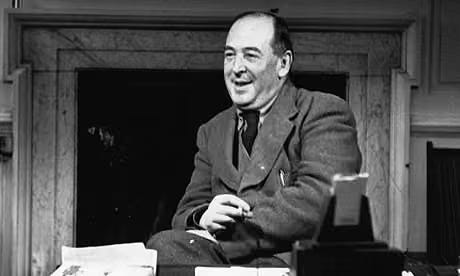
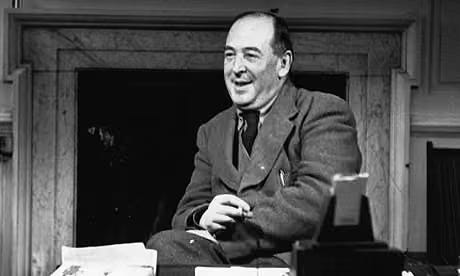
Getty
I am always left with the final picture of Lewis given to us by Vanauken: on the afternoon that they last shared a pint in a pub, they bid each other goodbye on the sidewalk, except—not quite. Lewis said that he wouldn’t say goodbye, as he was convinced that he and Van would see each other again.
Then he crossed the busy street, pausing on the other side, and yelled jovially over the traffic, “After all! Christians never say goodbye!”
“That is because you are older, little one,” answered he.
“Not because you are?”
“I am not. But every year you grow, you will find me bigger.”
C.S. Lewis, Prince Caspian
I first encountered Peter, Susan, Edmund, and Lucy in elementary school. I fell in love with the creaky old country house, the abandoned dusty rooms, and the magical wardrobe. At the time, I found kinship in the adventurous crowd of kids, ramming around in the rain inside a drafty country home, desperate for something to do. The house reminded me of my paternal grandparents’ home in the farm country of upstate New York. That house had once been a small hotel. It was drafty and cold. I slept in room number four at the top of the stairs.
At the time of my childhood, Lucy seemed like someone I’d like to be friends with. She was earnest, brave, and truthful. She loved doing, going, and experiencing. She couldn’t sit around. Susan seemed unrelatable to me: she was elegant and polite—so unlike me, who was clumsy and insecure. I wanted to run around the attics with Lucy, wearing knee socks and Mary Janes, opening doors and finding things out. She was someone I could follow into adventure.
And what younger sibling didn’t feel the pinprick of bitterness alongside Lucy when her older siblings didn’t believe her about her tea with Mr. Tumnus? The injustice of it all was familiar. My heart broke for her when she was dismissed and mocked. When Edmund has a chance to redeem her, he turns a deaf ear and exposes her to scorn. Later, my heart soared as she was proven right, and Peter, her brother-hero, confessed that he should have listened to her.
Imagine my surprise when years later, on a return to The Lion, the Witch, and the Wardrobe as an adult, I found it to be a story about Edmund. Edmund the terrible—the traitor. We spend chapters alongside him, filling up on hot chocolate and Turkish delight while he commits his villainy. Who could have guessed that this was not a story about Lucy?!
And yet, in my return, I found myself there as well: in Edmund, and not so much in Lucy. In greater self-awareness, I understood that I, too, had the capability to betray and fall short of the mark. Time and again, I would mix up service to others with service to self; I would pursue my agenda and forget others. It would take a surprisingly small amount of sweets to cave in my will toward evil.
In my return to Narnia in adulthood, Lucy was the ideal, but Edmund was my reality.
In my travels on the internet recently, I was searching for something about Edmund Pevensie. I noticed that the first selection of a “question people ask” Google is “Why is Edmund such a nasty brother?” I hope that this question is asked by people who haven’t yet “returned” to Narnia—perhaps they still have a childlike understanding of Edmund (and of themselves). Or maybe they just saw a bad movie portrayal of Edmund. Or maybe they haven’t read far enough yet.
Lewis tells us that the first time Edmund feels sorry for anyone but himself is when he sees the tiny dinner party turned to stone by the White Witch. Standing in the mud, he ponders the fate of the little animals, once joyfully feasting and full of life, now mute statues, frozen in time. Edmund finally feels a bit of empathy for another. It’s not sadness for his own betrayal of his siblings, but it’s a start. It’s not a coincidence that this is also the chapter when the snow is melting; the spell is breaking, and Aslan is nearer.
As the story of Narnia progresses and Edmund lives out the years beyond Aslan’s sacrifice on his behalf, he is named Edmund the Just. Perhaps Aslan understands that Edmund, of all the children, grasps justice better than anyone. Edmund would understand that justice is required, but it is best tempered by mercy. As we are told in James 2, “mercy triumphs over judgment.” We understand that in his later years, Edmund was “a graver and quieter man than Peter, and great in council and judgment.”
In subsequent stories, when it’s required, he is the first to believe Lucy, not the last. He is kind and understanding to Eustace as his cousin recovers from his dragonish exploits. Most poignantly, when the monarchs are prompted to execute Rabadash in The Horse and His Boy, it is King Edmund who first makes a case for mercy, saying “… even a traitor may mend. I have known one that did.”
So it would seem that for me, a return to Narnia meant not only that Aslan was bigger, but that I myself was smaller—more than that, that I was “right-sized.” More than when I was ready to tumble along behind Lucy, I had a sense that I was as frail, and as prone to wander, as Edmund. Edmund is the story of Romans 3:26, where God is shown to “be just and the justifier of the one who has faith in Jesus.” A traitor made new, Edmund rightly perceives the Just and Justifier, the One Who makes the wrong into right whenever He comes in sight.
You probably aren’t getting enough protein or fiber.
One of those polyps was precancerous. Do you have a family history?
How do I know when to get my car inspected?
I think my car got stolen.
We’re engaged! Hope you can be here for the wedding.
The EMTs didn’t think he was able to stay home safely, so they transported him to the hospital.
Did you take your magnesium today? If you don’t, you might not sleep tonight.
Can you edit this paper?
Have you had enough protein today? How about fiber?
Walking can only do so much. You should be lifting, and lifting heavy.
The car smells weird. Did you leave something in it?
The dog is acting strange. Did something happen while I was gone?
That limb finally fell out of the tree.
My car wasn’t stolen -- it’s only towed because I forgot to register it with the parking people.
How are your grades so far?
Everything is so dry. I hope it rains soon.
Take a deep breath, and try to relax. It’ll be over before you know it.
Can you quiz me on biology?
I’m retiring! You’ll have a new doctor come fall. I know you’ll like her.
I think the trip conflicts with her dentist appointment.
Are you driving safely?
Did you send them a thank-you?
Does the recycling go out today?
What do you want to major in?
The bees are dying. No wait, they're not.
The earth is so warm.
Do you have enough money?
The scan was inconclusive, so we’ll need you back in two months.
I got fired.
Have you had enough fiber today? What about protein?
The weeds are taking over that bed. It’s going to be worse next year.
I think his friends are using him, and he doesn’t see it.
Did you make your loan payment?
We don’t care about your grades. We love you no matter what.
I think the dishwasher is leaking. Look at the floor.
Maybe you need more bloodwork.
Drive safely.
When David and I moved to Northern California we attended a church plant that met in a synagogue. We made fast friends with a few young couples there, and the men were beginning to pass around CDs they’d burned of sermons from a pastor in New York City. His name was Tim Keller.
I think the first teaching I heard from Tim was about emotions. Most reformed teachers I’d heard up until that point were generally allergic to human emotion; strong emotions were one tick off from outright sin, and they ought to always be controlled by the intellect. (I’m exaggerating, but you get the idea.) Rather than letting emotions drive us up and down, or refusing to interact with emotions, Tim saw a third way (stop me if you’ve heard this one before).
I picked up his book A Reason for God as a potential resource for doubting friends; what I didn’t expect was that it deeply ministered to my own soul. I’ve already told you of the influence of his book The Prodigal God. We have a shelf full of his work, ranging from vocation to prayer to suffering.
I saw Tim speak a few times — once at Redeemer, where I was struck by his casual way of sidling up to the standup microphone and talking to a huge room of people as though he was sitting next to each of us. Kathy and Tim did the pre-conference at an event I went to once. He clearly delighted in his wife — such a fierce, intelligent, and funny woman.
We got to meet him once. He did a book signing here in Charlotte when A Reason for God came out. We waited in line and confessed to him that occasionally we referred to him as “Uncle Tim.” He chuckled and said, “Well, that’s alright. We’re probably related somehow.” Then he proceeded to unfold a brief Keller family history, tracing his family roots through the mid-Atlantic, until we had to gently call him to a halt and awkwardly excuse ourselves for holding up the line.
One thing I admired about him was his curiosity about the world and about people. In the five minutes we spoke to him, he wanted to know more about us — not because he was expected to, or because it was good manners, but because he was genuinely interested. When he heard Kathy talk, he wanted to know more about something she said or thought. The pattern continues in recorded conversations and interviews; he wanted to learn. His deep well of illustrations for preaching sprung from an unending desire to know more about God’s word, God’s world, or God’s people.
I was emotional the Sunday after he passed away. In church, we sang about Heaven, and I pictured him there, realizing what he’d clearly longed for his entire life. His teaching on vocation always included Tolkien’s story “Leaf by Niggle,” a story that has ministered deeply to my heart as I’ve tried and failed to accomplish so many things here on this fallen earth. When Niggle, the main character, reaches Heaven, he realizes that his work on Earth, though artistically frustrating, was not in vain. None of it was lost or wasted.
Before him stood the Tree, his Tree, finished. If you could say that of a Tree that was alive, its leaves opening, its branches growing and bending in the wind that Niggle had so often felt or guessed, and had so often failed to catch. He gazed at the Tree, and slowly he lifted his arms and opened them wide. “It’s a gift!” he said. He was referring to his art, and also to the result; but he was using the word quite literally. He went on looking at the Tree. All the leaves he had ever laboured at were there, as he had imagined them rather than as he had made them; and there were others that had only budded in his mind, and many that might have budded, if only he had had time.
Keller wrote in reflection:
Once or twice in your life you may feel like you have finally “gotten a leaf out.” Whatever your work, you need to know this: There really is a tree. Whatever you are seeking in your work—the city of justice and peace, the world of brilliance and beauty, the story, the order, the healing—it is there. There is a God, there is a future healed world that he will bring about, and your work is showing it (in part) to others. Your work will be only partially successful, on your best days, in bringing that world about. But inevitably the whole tree that you seek—the beauty, harmony, justice, comfort, joy, and community—will come to fruition. If you know all this, you won’t be despondent because you can get only a leaf or two out in this life. You will work with satisfaction and joy. You will not be puffed up by success or devastated by setbacks.
(from Every Good Endeavor)
I’m thankful for the good endeavors of Tim Keller’s life. I pray that I and others will have the same curiosity and joy in our earthly work and play until our race is run.
It’s almost time for the start of the English Premier League. At this time last year, I was recruited by a friend to help her select a team to cheer for. She is now happily a fan of one of the teams below.
Now, like that annoying married person who’s had one success fixing up a single friend, I am (wrongly) drunk on success and giddy for more. That means I want to match you to one of the teams below. Kickoff for the next season is Friday, August 11 at 3pm Eastern time, so you’d best get to reading.
If you have actual in-depth knowledge of the sport, this guide will be of no use to you. But then, if you’re that person, you should have picked a team by now. What are you waiting for?
This guide is best put to use by people who are trying to be interested — just dipping their toe in the water. It would also be helpful to those who find amusement in funny mascots.
We love watching EPL partly because it sets a restful tone for the weekend. It’s a nice rhythm to Saturday to brew a hot drink and settle in on the couch in your PJs before the day starts in earnest. However, if you’re a churchgoer, the schedule will be endlessly frustrating to you on Sunday mornings. Proceed with caution!
Newcastle Upside: Newcastle came on strong in the second half of the season last year and finished in fourth. They were the little team that could. They don’t have any superstars to name (though they have many excellent players), but they were hard to beat. Downside: Black and white stripes…meh. Their back line (defenders) might be a little weak. Notable Players: Kieran Trippier, Miguel Almiron (Paraguay), Callum Wilson (ENG)
Liverpool Liverpool is a powerhouse, both in talent and fan culture. The northwestern city is proudly blue-collar and distinct from the rest of England. The club was founded by people who were priced out of the top tier of football. Upside: Their current manager is a delight: fiery German Jurgen Klopp. Screams when he’s mad at the refs; hugs everyone when it’s over. He’s terribly hard to dislike (I’ve tried). Downside: That thing that makes the Boston Red Sox unlikeable? Kind of a little-brother attitude even though they’ve been successful? That’s what Liverpool feels like. Some people would view this as an upside. Notable Players: Egyptian Mo Salah, their striker, is amongst the most dangerous scorers in the sport.
Manchester City I root for Man City largely because my first encounter with Premiere League soccer was the Amazon documentary All or Nothing, focusing on the Man City 2017-18 season. Players like Vincent Kompany and Sergio Aguero (both now retired) won my heart. Upside: Their manager, Pep Guardiola. He is from Spain, and before he was at City, he coached what many regard to be the best team in history, Barcelona (2008-2012). Pep is slightly crazy in the way that you want your manager or coach to be. Obsessed, intense, passionate — and he’s funny with the press. Downside: If you choose Man City as your team, longtime Premiere League fans will roll their eyes at you and accuse you of being an unthinking bandwagon fan. This is because Man City has been fairly dominant lately. But I think this means you just arrived at the right time. Welcome! There is room for you here. Also, there is the unfortunate “oil money” association that comes with being a City fan. You know all the talk of morality and business dealings that has been going on in the PGA this year? The conversation is years-old in the soccer community. Notable Players: Everyone. Seriously, this team is deep. Kevin DeBruyne, the Belgian midfielder, merits a mention here, though. The way he passes is a thing of beauty. City just picked up Erling Haaland, who’s brash and young and doesn’t know enough to hedge his bets, so he just keeps scoring goals.
Manchester United United is the New York Yankees of the Premiere League. They dominated the competition in the 90s and 2000s under their legendary manager, Sir Alex Ferguson. Thus, everyone outside the fanbase feels about United the way they do about the Yankees here in America: anyone but them. They are actually owned by the Glazer family, owners of the Tampa Bay Buccaneers. The fanbase largely hates the Glazers and wishes they would sell. If you spot yellow and green fans in the stands during United matches, that’s an indication that they are anti-Glazer fans. Upside: An unrivaled legacy of success. A stake in the most hotly-contested Derbys of the year: the Manchester Derby (City vs United, played twice each season, once at each ground). Their new manager is straight as an arrow and doesn’t put up with foolishness (he benched Christiano Ronaldo, one of the best to ever play). Downside: Just, blergh. Do you really want to root for the Yankees of English football? Notable Players: I love Marcus Rashford and Jadon Sancho, both young English players just coming into their own. Rashford received an OBE for working to keep poor kids fed during the pandemic.
Brentford Brentford was promoted just recently, in 2021. They have done very well in holding their spot in the top tier. Upside: Their manager, Thomas Frank, is incredibly likable and enjoys what he does. He’s easy to root for. If mascots are important to you, Brentford is the BEES, which is adorable. They’re fun to watch in that they are on the small side but work really well together. Downside: The squad is a bit young and inexperienced. They recently lost their star striker, Ivan Toney, because he was betting on his matches. Notable Players: Ben Mee, Bryan Mbeumo, and midfielder Yoane Wissa; Josh Dasilva is another good midfielder.
Chelsea Chelsea is one of the bigger London clubs, with a long history and a loyal fanbase. They were a force in the 2000s and have continued to compete. They recently went through a tough time with their ownership; they were owned by a Russian oligarch, who sold them when the war in Ukraine began. This brought about many financial challenges for the team. Eventually, they were bought by Todd Boehly, who owns the LA Dodgers. He is ridiculously out of place in the stands because he looks like he is from California because he is from California. Upside: Their new manager, Mauricio Pochettino. He is fantastic. I hope the ownership is patient enough to let him have an influence. Downside: Chelsea seems to be always flirting with dominance but hasn’t zeroed in recently. They go on winning streaks and then go into a tailspin. It has caused much angst for my son, Jonathan, who cheers for them. Notable Players: I’m a big fan of Reece James, who plays right back (his sister plays for Chelsea Women). Raheem Sterling seems to finally be hitting his stride with Chelsea (maybe?).
Tottenham Hotspur (Spurs) Spurs is where you will find Harry Kane, captain of the England team, tied for all-time scorer for England. This is one of the most dominant Premier League teams, usually expected to finish top-four or at least top-six. Anything lower than that is viewed as a failure. Upside: They have a beautiful new stadium. It’s stunning. If kits (uniforms) are important to you, I think they have some of the best. Plus they win a lot! Downside: You’re never really sure they’re going to win. Notable Players: Kane, as I mentioned above. In the World Cup, Kane had to take penalty kicks against his teammate, Spurs keeper Hugo Lloris. Also with Tottenham is Son Heung-min, who is a dangerous scorer at times.
Wolverhampton Wanderers (Wolves) Wolves are my husband’s chosen squad, having been influenced by some English friends who hail from the area. Upside: They are called the “Wanderers” in tribute to older teams who didn’t have a stadium for a while. They “wandered” to different locations for home matches. In general, Wolves have a “down-on-our-luck” kind of feel. It’s sort of a Chicago Cubs flavor, which, come to think of it, is maybe why my Cubs fan husband felt comfortable here. Downside: They flirted with relegation last year. They finished 13th, but it wasn’t comfortable. Notable Players: Fabio Silva (Portugal). Also, their attacker Adama Traore is hilariously out of place on the pitch, since he looks more like an American football player. Apparently, he once claimed that he only does “bodyweight exercises.” Look him up and you be the judge.
Brighton Hove-Albion Brighton is a seaside city to the south, and their team is another “no superstars, just a great team” kind of pick. They lost their (great) manager last year after a successful start, but they eventually recovered from a slide and wound up fifth. Upside: Fans of sophomoric humor will enjoy the seagull poop arrangement of the stadium (it has since been remedied). More seriously, this is just an eminently likable set of players who work together well, especially in the midfield and backfield. Downside: Their lack of a star striker is making scoring difficult, but maybe this will change this season. Notable Players: Lewis Dunk, the tall defender, is usually the captain. Brighton just picked up James Milner, who was with Liverpool until now. James Milner has the unique position of being the Premiere League player I think who looks most likely to get into a barfight.
Arsenal Arsenal is an older London team with a young manager and an even younger squad. They dominated for most of last season before injuries took them down. They finished a tight second behind City. I find it easy to root for them when they’re not playing against my team. Upside: They have some really fun lingo. They are the “Gunners,” pronounced (and sometimes spelled) “Gooners.” London teams always get lots of attention. Mikel Arteta, the manager, is intense but very funny, like his mentor Pep Guardiola. Downside: We’re having trouble coming up with one. Notable Players: So many! This team is very deep. You have Eddie Nketiah, Bukayo Saka, Martin Odegaard, and the USA’s own Folarin Balogun.
Nottingham Forest Upside: I mean really. Can you think of a more charming name for a team?! Their mascot is a TREE. A TREE! Plus, Robin Hood and all that jazz! These guys were promoted last year and they ended up doing really well. Downside: Their defense is weak. Notable Players: Brennan Johnson from Wales; Nigerian Taiwo Awoniyi and New Zealander Chris Wood are both leading scorers.
Luton Town Upside: If you weren’t sold on the tree thing with Forest, this team is called “the Hatters.” THE HATTERS — like, the people who make hats. This team plays in a tiny little stadium in a neighborhood, and they had to do some construction to be able to host matches for the top-tier teams. If you want the underdogs, here they are. Downside: Teams that are recently promoted, like this one, are the most likely to get sent back down. It’s just statistics. Notable Players: One of their midfielders is named “Marvelous.” Elijah Adebayo is one of their best scorers. I can’t help you with others because they seemingly came out of nowhere.
Burnley Upside: Burnley is returning to the PL after two years out of it. Their manager, Vincent Kompany, used to play for Pep at City. He is a brand-new manager but he seems to have the hang of things already. He’s easy to cheer for. Downside: Again, always a danger picking up a newly-promoted team, but maybe you want to roll the dice here since the squad has been there before. Notable Players: Wout Weghorst scored the equalizer in that Netherlands World Cup match that went on forever (maybe you were watching?).
Alright, I can’t say more words here. I am no doubt going to be criticized for misrepresenting or leaving off someone’s favorite, to which I must answer, “What did you expect?! I am not good at this, but I am having fun.”
(Back by popular demand: here’s what I wrote to my newsletter subscribers in May of 2022.)
Hi Guys.
Maybe this email has been politely forwarded to you by your wife or one of her friends. Welcome, I’m glad you’re here. I’ll try not to take up too much of your time.
I’m going to fully lean into my position as a mid-40s woman to get bossy about some things. You can choose to ignore me as you would a bossy older sister, or you can choose to listen to me and make this year a lovely one for your wife.
This is it: the very practical stuff that you might need help with. I get that everyone has different plans, different people, different needs, and different budgets.
This should not be read as condemning what you’ve done thus far for Mother’s Day. You’re doing great. We’re not dwelling on the past. Let’s huddle up, team.
First off, you need a plan. If you haven’t thought about Mother’s Day yet, today’s the day. Get a plan. Make some decisions. I think guys get tangled up in knots about what to do, feeling like they’re never going to get it right. Repeat after me: something is better than nothing. Decide to decide. Think it over, make a plan, execute the plan. You do this every day in other areas of your life. Apply that same method here. Make some decisions.
Here are some things you can do TODAY: call the florist and order flowers to be delivered Friday or Saturday of next week (she gets to enjoy them all weekend!). If she’s the breakfast-in-bed type, locate a pancake recipe to shepherd your children through next weekend. Make a grocery list to shop for next weekend, so you have a nice breakfast for her. Buy a few tiny gift cards for the tiny children to put in their cards for Mom (She will be so happy! They will feel so proud!). Cards can be store bought, or if your kids are little, handmade. Go on Groupon and buy a voucher for a housecleaner or a spa day, which mom can arrange at her convenience.
Do you have tiny children who cling to your wife like their very lives depend on her? I’m willing to bet that she wants some time alone for Mother’s Day. She wants to think a complete thought.
If you have older children who are capable of pitching in around the house, consider rallying them to do all those household chores that she nags them about every day of her life.
BUT ALSO: I will tell you a secret. Mom may instead desire time ALONE IN HER HOME. This is so weird, you guys. SHE IS NEVER IN YOUR HOUSE BY HERSELF. I am going on twenty-two years of motherhood and it’s still very rare that this happens for me. It’s so rare, in fact, that my brain melts a little bit when it happens. I’m not sure what to do when I’m home alone. Perhaps she would like the people to GO AWAY FROM HOME FOR A WHILE.
BE CAREFUL: if it is her usual job to feed people, she would like to not think about feeding people today. If you choose to take the children away from her for a day, DO NOT BRING THOSE CHILDREN HOME HUNGRY. Feed them. Bring them home happy, fed, drunk on Dad Attention. Have. A. Plan. And Chick-fil-a is not open on Sundays, so that’s a bad plan.
(How are we doing, team? Still here? OK, we’re almost done.)
Lastly, she wants to know that she’s doing OK. Tell her. She might feel a little guilty that she’d like some time away from the kids. This is ridiculous. Tell her so. Children are wonderful and also exhausting. We all understand this.
Fist bump, you guys. I’m in your corner. You can do this. Report back here with how it goes.
I love January. I know it’s cold and dark and everyone’s miserable, but I’m not. I like the excuse to stay in, huddle under a blanket, and make soup. This is probably the month when I like homeschooling the most, because while the rest of the world is outside waiting for buses and warming up the car, we’re still inside sipping hot drinks by the space heater.
Other months are showy, demanding us to celebrate holidays, decorate loudly, and fill our calendars. January is quiet, slowly allowing the light to grow longer and easing the daffodils up from their sleep. January coos to us, “Free up some space now. Slow down a bit. You need to rest.” If we are wise, we oblige.
January is full of hope. She hands us a clean calendar and encourages us to dream. She reminds us that we are mortal, hemmed in by hours, days, and weeks, and light and dark. Still, she urges us to rise above and make this year something unique and wonderful.
January is the clearing-out time. Christmas comes with all its joyful trappings and threatens to take over the place; January is our sister in solidarity saying, “here you may come, and no further.” We overwhelm donation centers with those things we thought we needed until just now.
January is kind to us in making us reevaluate. The loud voices in our heads tell us to achieve more! Do more! Go further! January quietly suggests that it might be better to do well at those things we’ve already undertaken — for the glory of God and not ourselves, for the benefit of others.
We’ll be distracted soon enough by other months. Hail, January. I love you. Do your good work while you’re here.
(This was originally published in On the Common in December 2021)
A date that is coming up on my calendar is my yearly “meeting with myself.” I’ve had a few friends ask about this annual ritual, so I thought I would try to recap some of what I do during that day. It has become a precious time for me, one in which I put the old year to bed (as much as I can) and prayerfully set out intentions for the next year (as much as I can).
Keep in mind that my thoughts, questions, and intentions are very specific to my job over the years: a stay-at-home homeschooling mother of five children. If this is not your job, your day should look different and consider different things.
Also, please keep in mind that I didn’t do this last year. It was too difficult for me to think ahead and make plans mid-pandemic. Quite frankly, it was too sad. I felt overwhelmed by a lot of things. If this is how you feel this year, maybe a better use of your time would be to schedule a hike for yourself, or a day of shopping, or a movie marathon at home.
OK, enough with the caveats. Onward.
An underrated part of this exercise is going to a place you like. You can do this at your house, for example, if you have little children for whom you are responsible. However, if you can arrange to have the children looked after for a few hours, you will find yourself oh-so-much-more refreshed and able to focus. I usually try to have this meeting during the week between Christmas and New Years, which is quite possibly my favorite week of the year. I think we should call it The Week of Appropriately Low Expectations.
Anyway, find somewhere you like to be alone: a cafe or a park or a library. Order yourself a pot of tea or a full French Press, and dive in.
I begin with what Sally Clarkson calls “decluttering your soul” — a careful evaluation of the need for confession, spiritual weakness, or guilt. Just as we spend time clearing out the clutter from our homes around this time, we can spend some time identifying and praying through things that might need to be addressed at years’ end.
This part of the day might leave me with things I need to talk through: with a counselor, a friend, a mentor, or my husband.
Goals for Me/Goals for Others
Then, I move on to working through goals for the year, in different areas: physical, emotional, and spiritual. This portion includes answering questions like:
What exercise/health goals do I have for this year? What measurable steps can I take to achieve them?
How can I make sure I’m getting enough rest?
Are there improvements I can make to any relationships? Family? Friends?
What spiritual disciplines do I want to work on this year? How will I go about it? What books do I want to read for spiritual improvement and accountability this year? What Bible verses would be helpful for me to memorize and meditate on in this season of my life?
Now, real talk for a second — my number one weakness in this exercise is that I want to do ALL THE THINGS! AS SOON AS POSSIBLE! The key to these questions is understanding the season you’re in, being patient with yourself, and setting realistic goals.
For me, in years past, this has looked like any of the following (not a complete list):
One year, I had some lofty running goals. I put my running schedule on my google calendar because when that’s done, I plan better around it and actually do it.
I scheduled a one-on-one with each of my kids each month. These dates also needed to go on the calendar.
I made a list of the books I’d like to read or revisit that year. I am never at a shortage for things I’d like to read, but I try to be intentional about which ones would serve my season of parenting, my discipling relationships and my current struggles. This is also the moment when I give myself a lecture about reading books I already own instead of buying more (anyone else?).
Every year at this time, I concretely plan for what I’m studying in the Bible this year. “Concretely” means I have to decide today — no putting it off, although I reserve my right to change my mind. This step might involve ordering a book or study.
The next thing I consider is my marriage. This is a section where I might have more questions for David than answers for myself at the moment. We usually have a follow-up meeting in the following week, considering things like expectations, communication, and the like. We also go over the portions below dedicated to the kids and looking ahead at travel for the year.
Next, I move on to each of the kids. Are there things that are getting overlooked for any of them? Requests they’ve made? Areas of learning where they might be slipping? Adjustments that need to be made? Ways we can pray for them? Being a mom of a lot of kids means that I sometimes think of them as a group instead of individuals. This is a moment to spend on each one alone.
Time for Fun
Then I move on to working on goals for fun. We are a family that likes to go places! Here are some of the ideas I’ve come up with in the past for cultivating fun and rhythms of rest and enjoyment in our family:
My younger kids used to enjoy teatime once a week. I put it on the calendar. (You should notice by now that my google calendar runs my life!)
I tweaked our approach to evening reading time with David so that it was more restful and less squeezed.
I put a date on the calendar each month for us to do “city schooling.” The kids loved to do school in other places, and I did too. A change in atmosphere is so refreshing!
The biggie: I wrote down all the trips we want to/need to take in the year, when they were scheduled, and any approximate costs we would incur for them. Here’s hoping we’ll be traveling more in 2022.
When I’ve worked through myself and the family, if I have time left, I spend time on some other things. Since I’m trying to blog more regularly, I might make a list of topics I’ve been mulling over but haven’t gotten to yet.
All of this sounds dreadfully boring, doesn’t it? But it nails down some structure for human flourishing. It sets goals for soul-feeding. That’s what we want — to catch these days and bend them to our wills. We want to redeem the time and use it well (Eph. 5:16).
I want to emphasize that your structure will look different from mine. Life stages, employment, ages of children, and priorities dictate how we spend our time and honor the Lord with it. The schedule may fly out the window due to sickness, adding a baby, moving, job changes, etc. But an underlying structure can give a family a rhythm to return to.
James 4:13-15 Come now, you who say, “Today or tomorrow we will go into such and such a town and spend a year there and trade and make a profit”— yet you do not know what tomorrow will bring. What is your life? For you are a mist that appears for a little time and then vanishes. Instead you ought to say, “If the Lord wills, we will live and do this or that.”
Psalm 90:12: So teach us to number our days that we may get a heart of wisdom.









 Kelly Keller