All four Gospel accounts in Scripture—even brisk Mark’s—mention the casting of lots for Jesus’ clothing at the foot of the cross. The actions of the soldiers on the mount of crucifixion, playing a game of chance to obtain Jesus’ robe, were foretold in Psalm 22:18, “They divided my garments among themselves, and they cast lots for my clothing.” This was not the purple robe that was cast over his shoulders as they mocked him, but a seamless undergarment, as described by John.
This event is not the first time we hear about Jesus’ clothing. From birth, when he was wrapped in swaddling cloths by his mother, Mary, to the woman in Matthew 9 who cried out, “if I could just touch the hem of his garment, I will be well,” to this scene at the time of his impending death, Jesus’ clothes are a part of his earthly days, just like ours.
In the Old Testament, we are given a depiction of some other garments. These pieces belong to the Father, the righteous judge, carrying out the sentence on his enemies:
Who is this coming from Edom
in crimson-stained garments from Bozrah—
this one who is splendid in his apparel,
striding in his formidable might?
It is I, proclaiming vindication,
powerful to save.
Why are your clothes red,
and your garments like one who treads a winepress?
I trampled the winepress alone,
and no one from the nations was with me.
I trampled them in my anger
and ground them underfoot in my fury;
their blood spattered my garments,
and all my clothes were stained.
(Isaiah 63:1-3, CSB)
The depiction of God’s wrath here in the winepress of justice is comprehensive: bloody, splashing, soaking his garments with stains, and without restraint. Every bit of his clothing is saturated with the blood of his enemies. The sin that stains his garments is that of the world: his enemies are rightfully trodden upon as God pursues justice and fulfillment of his holy law.
In this picture of judgment against sin, we may be reminded of Aaron’s garments being sprinkled with blood in the dedication of the temple and priesthood by Moses (Exodus 29, Leviticus 8). The tabernacle, and later the temple, was a bloody place, a constant reminder that without the shedding of blood, there is no remission of sins (Hebrews 9:22).
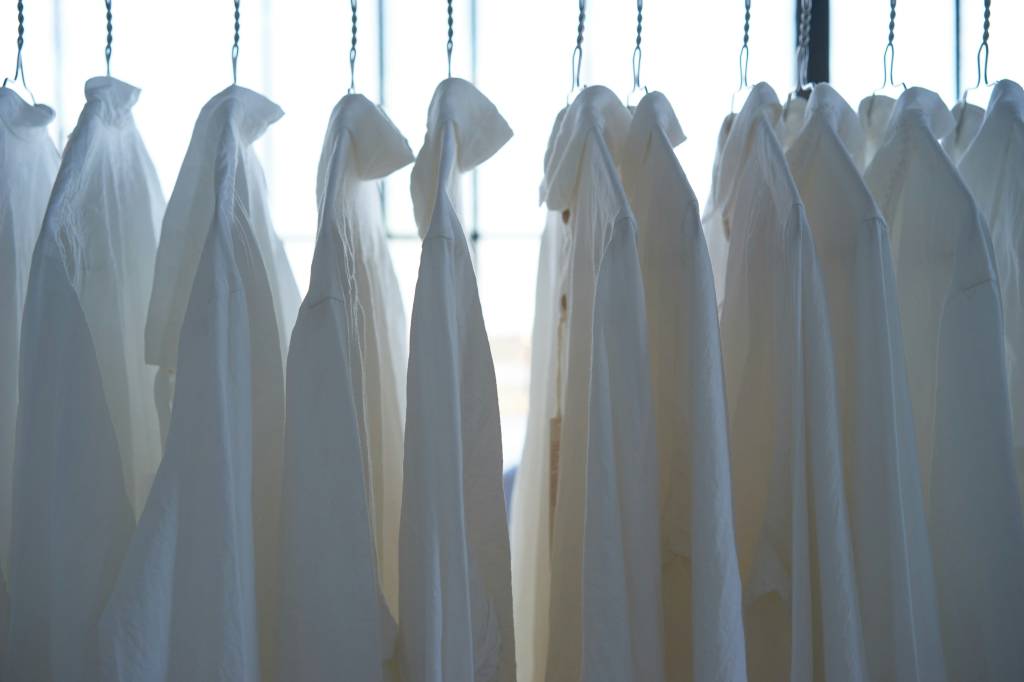
But at Calvary, as the soldiers played games of chance at his feet, Jesus took the crushing weight of the winepress on our behalf. “Upon him was the chastisement that brought us peace.” (Is. 53:5) His scarlet blood flowed, but the result was the great reversal of the stain: we were made clean. Instead of deep crimson, our clothing was made white as snow. His bloody death removed the stain from our garments. Death was made to submit to greater life. The wrath has been satisfied; Christ’s blood does not stain, it cleanses. It is a bleaching crimson.
As Christ’s garments without a seam are gambled for; as our garments are made whiter than snow, the heavy woven curtain in the temple is torn top to bottom, never to be sewn again. Here also is a piece of cloth without a seam—because it needs no seam. It is permanently severed. Those whom the lamb’s blood has covered can enter the Holy of Holies.
Then one of the elders asked me, “Who are these people in white robes, and where did they come from?” I said to him, “Sir, you know.” Then he told me: These are the ones coming out of the great tribulation. They washed their robes and made them white in the blood of the Lamb.”
Revelation 7:13-14
Love is that liquor sweet and most divine,
Which my God feels as blood; but I, as wine.
(George Herbert, “The Agony”)


Leave a Reply