Blog

  • The Unlived Life

    The Unlived Life

    “…on days like today, in places like this, in company like this, you get a glimpse of what it all might have been like: the unlived life, and how much happier it might have made me.”

    If you’re not up-to-date on recent English history, it might surprise you to know that the recently-departed Queen, the one who reigned longer than any other monarch in history, was not supposed to be Queen. She was Queen because of the decisions of others. Her uncle, Edward VIII, abdicated the throne after just eleven months. He wanted to marry the American divorcee Wallis Simpson; for so many reasons at the time, as head of the Church of England, he simply could not if he were king. So he stepped aside, the only British sovereign to ever do so.

    In his place came his younger brother, George VI, the one who famously struggled with public speaking. He led the nation through the Second World War, by all accounts doing so quite well. He had two daughters, Elizabeth and Margaret. After sixteen years of his reign, he passed away, leaving his oldest, just twenty-five at the time, as Sovereign.

    Elizabeth was occasionally caught implying that she would have rather been a plain English countrywoman. She was happier in her muck boots in the farmyard than at state dinners with a tiara on her head. I suppose for a short time, as a little girl, she assumed that she would be just that: able to live her life in relative obscurity in the countryside, riding her horse daily and breathing the clean air. It’s understood that she was always happiest in Scotland for this reason. She spent nearly three months every year in the Scottish countryside, perhaps attempting to grasp at that existence that had escaped her.

    Elizabeth II in 1936, the year her uncle abdicated

    There’s an episode of The Crown which attempts to capture this desire of the Queen. Elizabeth is depicted having dinner with a childhood friend, one who has always shared her passion for horsemanship. They are sharing a meal after spending the day in the country, evaluating different horses and riding. She reflects, “Somehow today has managed to be one of the most enjoyable days of my life. And at the same time, one of the most depressing.”

    She goes on, “This is how I’d like to spend all my time…It’s what makes me truly happy. And I actually think it’s what I was born to do…until the other thing came along…that someone else was born to do, that they elected not to do, which meant that first my father, and then I, had to do a job we were never meant to do.”

    Though we can never attempt to relate to Queen Elizabeth’s life — she operated in a realm none of us will ever see — all of us might learn from her assumption of her role, a role she never desired. There come moments when all of us must make peace with closed doors. We must bow the knee to the Lord’s established will.

    These circumstances creep up on all of us. Some are gradual in nature: we make tiny decisions day by day, and suddenly we find ourselves in a different spot than where we thought we would be. Some circumstances come in like a thunderclap: a death. A lost job. A divorce. A rejection.

    Or sometimes, the differences are favorable for the most part, but on hard days, we still wonder what it might have been like somewhere else. And suddenly we are on an island, miles away from where we’d intended to be, grieving what might have been and confused about what happens next.

    Those thoughts come up: what might have been. What might have happened. A different life.

    On our best days, we want to channel Mary’s submission to God in Luke 1: “Behold, I am the servant of the Lord; let it be to me according to your word.”

    But the decisions we make over the course of a lifetime don’t usually have the blazing certainty of an angel visiting us with a word from God. We take steps, we attempt to live faithfully, and eventually, we must make peace with the doors that have been closed to us. We might wonder what might have been, but we must walk forward into what is, trusting that the Lord will meet us there. I am reminded of the passage from Ecclesiastes:

    I have seen the business that God has given to the children of man to be busy with. He has made everything beautiful in its time. Also, he has put eternity into man’s heart, yet so that he cannot find out what God has done from the beginning to the end. I perceived that there is nothing better for them than to be joyful and to do good as long as they live; also that everyone should eat and drink and take pleasure in all his toil—this is God’s gift to man.

    Ecclesiastes 3:10-13

    I am thankful for the Queen’s example in how we might welcome circumstances we would not have picked. The door was closed to her preferred existence when she was just ten years old, by the decisions of her uncle. She took on the role that was thrust upon her when she was just twenty-five. Later she would navigate the rumors and indiscretions of her family; untimely deaths, criminal behavior, and private matters made public. Who knows what tearful hours accompanied her through the “annus horriblus” of 1992.

    By her own statement and others’ reports, she was a woman of deep Christian faith who no doubt leaned on prayer and meditation on God’s faithfulness to see her through. I am chastened to do the same.

    (Plus, it couldn’t hurt to keep riding horses)

    At age 94, during covid lockdown

  • Be a Plodder

    Be a Plodder

    (Republished. Originally shared in January, 2016)

    The other day I was listening to a podcast about home education, a decision in life which requires more than a little long-term perspective. The guest, who had herself raised and educated six children at home, attributed much of her success to being a “plodder.” She said one of her friends called her a plodder after observing how she faithfully, day-in-and-day-out, made her plans and executed them. Her efforts were nothing flashy, but her consistency over the long haul meant that she reaped great fruit after a time.

    I suppose this is nothing more than a retelling of the Tortoise and the Hare, but of course it’s true that “slow and steady wins the race.” All our extravagance and attempts at quick success cannot substitute for consistent effort over the long haul. We cannot make huge strides each day, but we can take one more step, try one more time, get up one more morning and do it again. All of these little efforts add up to more than we could ever achieve in one day of monumental success.

    Plodders are everywhere, but you often don’t see them. They are quietly making progress behind the scenes while the whole world clamors for more attention. They get up early and unlock the church. They put the last few dishes in the dishwasher before bed. They show up on time. They take their vitamins and walk the dog. They make the hard phone call. They practice their instruments every day. They budget. They listen longer and think for a minute, then they get back to work.

    At the top of my plans for school this year I have written in capital letters, “BE A PLODDER.” This sentiment is not to inspire mediocrity in myself or my children, but rather to inspire consistency, or, as the Bible observes it, faithfulness.

    How is God a plodder? Where is He quietly faithful? His excellency is seen in the sun rising each day, the rain falling on the just and the unjust, the turn of seasons, and the steadiness of the tides. This is the quiet, common grace extended to all as a manifestation of His undiminished, extravagant glory.

    But usually, we are all too busy to notice.

  • Imagining for Others: Steinbeck’s East of Eden

    Imagining for Others: Steinbeck’s East of Eden

    I spent most of the last summer with the Trasks and the Hamiltons. East of Eden, John Steinbeck’s masterwork of four-hundred-plus pages had long been on my to-read list, and with the help of my book club, I finally got through it. Steinbeck himself considered it his finest novel; after finishing it, he said “I have put all the things I have wanted to write all my life. This is ‘the book.’” It is not an easy book. It’s quite bleak. The story is Steinbeck’s retelling of the patterns of sin and alienation birthed in the Cain and Abel story in Genesis 4: “And Cain went out from the presence of the Lord and dwelt in the land of Nod on the east of Eden.” (Genesis 4:16)

    Many themes are explored in the book, but what stood out to me as a reader is East of Eden were the instances of people “imagining others” — either for their good or for their ill. Adam Trask, the protagonist in the first half of the book, makes his beloved into a beautiful thing to be attained to, even though she is in fact, as Steinbeck says, “a monster born to human parents.” She is irredeemable in everyone else’s eyes but Adam’s. He is willing to do anything for her, even as she works to destroy him and the life he attempts to build for them.

    A generation later, Adam’s son Aron Trask begins down the same road his father took with a woman: this time with his childhood friend and eventual girlfriend, Abra. Though she is not the force for evil that Cathy was, Abra feels the negative consequences of Aaron’s unsuitable idolatry of her. Aron makes Abra his entire world once he discovers that the adults in his life have all lied to him. From the age of twelve, he is infatuated with Abra; she is the only person in the world to him. By the time he is in college, Steinbeck tells us, Aron has made her “his immaculate dream and, having created her, fell in love with her….The results were love letters that dripped with longing and by their high tone made Abra very uneasy.”

    Later, after circumstances separate the couple, Abra confesses some relief. In a conversation with Lee, a family friend, she says “Lately I never felt good enough. I always wanted to explain to him that I was not good.” “And not that you don’t have to be perfect, you can be good. Is that it?” Lee replies, understanding her. Abra was exhausted by the weight of Aron’s false expectations of her: she knew she could never be the perfect one he perceived her to be. When the pressure was removed, she felt free to be just good.

    On the other hand, Caleb, Aron’s twin, has always been haunted by escaping people’s bad expectations of him. He also has his own bad expectations of himself, understanding himself to be a victim of his inclinations towards evil, inherited from his mother, Cathy. Cal eventually has a moment of clarity when he renounces this idea. Face to face with his mother, he can say “I don’t have to be you… I just know. It just came to me whole. If I’m mean, it’s my own mean.” At last, he knows he is not susceptible, caught up in generational sin, and unable to change things. He is finally able to imagine his way forward.

    I understand that John Steinbeck and I would probably part ways theologically much of the time, but his focus on the imagination in this novel made me, as a Christian, pause. How many of my earthly relationships are affected by this exact phenomenon: I presume someone to be something they are not; or worse, I essentially aid someone in being less than they could be, because I don’t allow for it? Do I hold back encouragement or joyful expectation on someone else’s behalf because I can’t imagine that God would make them, or their circumstances, into something wonderful?

    As Christians, we are all on the path to being made more like Christ. Sanctification is a long road, full of trips and hiccups along the way. What I understand to be sanctification in my own life might look like a stagnant season to you, and vice versa. I wonder how our perceptions of one another — and our tendency to focus on one another rather than run our own race (I Thess 4:11) — might hold back greater encouragement, greater love, and even greater growth.

    We are also prone to be tempted in the other direction Steinbeck explores in the novel: that of idolatry of one another. I often see brothers and sisters set someone on a pedestal: this could be a spouse, a friend, or a spiritual leader of some sort, only to have that person be, in time, unsurprisingly human. The Christian’s hopes are dashed as they see sin and struggle in this person’s life. We will never be truly free to love people in their humanity if we don’t first allow them to be human.

    One instance in Scripture where I speculate that this phenomenon of “imagining for others” plays a part is the story of Barnabas, Paul, and John Mark in Acts 15. When Paul and Barnabas were ready to move on to the next location in their missionary journey, they had a harsh disagreement over John Mark. Was he ready to come along? Paul thought no; Barnabas said yes. They ended up parting ways over the disagreement, and John Mark continued on with Barnabas, while Paul went on alone.

    We cannot conclude from what Scripture offers us, but I wonder about this moment in time with these three men. What role did imagination-for-others play in this situation? Was Paul’s resistance to Mark’s ministry a failure of imagination on his part — one where he simply could not picture Mark being able to handle the demands of the next stage of the early church? Was Barnabas a “son of encouragement” because he was able to see better — imagine better — what the Lord was capable of achieving in and through certain people? 

    Eventually, we come to a happy ending in this story: Paul, at the end of his life, aging in prison, calls for John Mark, as he has become “very useful to me in ministry.” (2 Tim 4:11)

    I find myself chastened to imagine well of others if I am to be a good encourager. It is an act of faith to look at another fallen human being and say, “I can imagine the Lord doing this through you.” It is the heart of encouragement to picture, to imagine, where someone has been and where someone might be headed. It is a bolster to hear from another believer, at least, that now that we don’t have to be perfect, we can be — and we are — good.

  • You Can’t Do Everything: The Goodness of Our Limitations

    You Can’t Do Everything: The Goodness of Our Limitations

    When life shut down in March of 2020, I saw friends adjust in many ways. Families set up rooms for online learning; healthcare workers developed new homecoming routines as they strove to protect their families; birthday parties became drive-by affairs. 

    One friend started sleeping more than he had in decades. This was not the embodiment of some deeper depression or problem, but just that he needed the rest. He would get up, work his corporate America job from home for some hours, eat, and then sleep some more. He slept for hours on the weekends. When he confessed to my husband and me that this was how he was passing the time of intense social distancing, I scolded him in a sisterly manner. “You never stop!” I cried, “do you see how you needed to?” He took the scolding well. He agreed that, since the time he was in graduate school more than two decades earlier, he hadn’t stopped. He is a tireless servant to our church body and a high achiever at work; he hardly ever sets limits on himself. Pandemic restrictions meant that he finally let himself stop, and he benefited from the forced limitations.

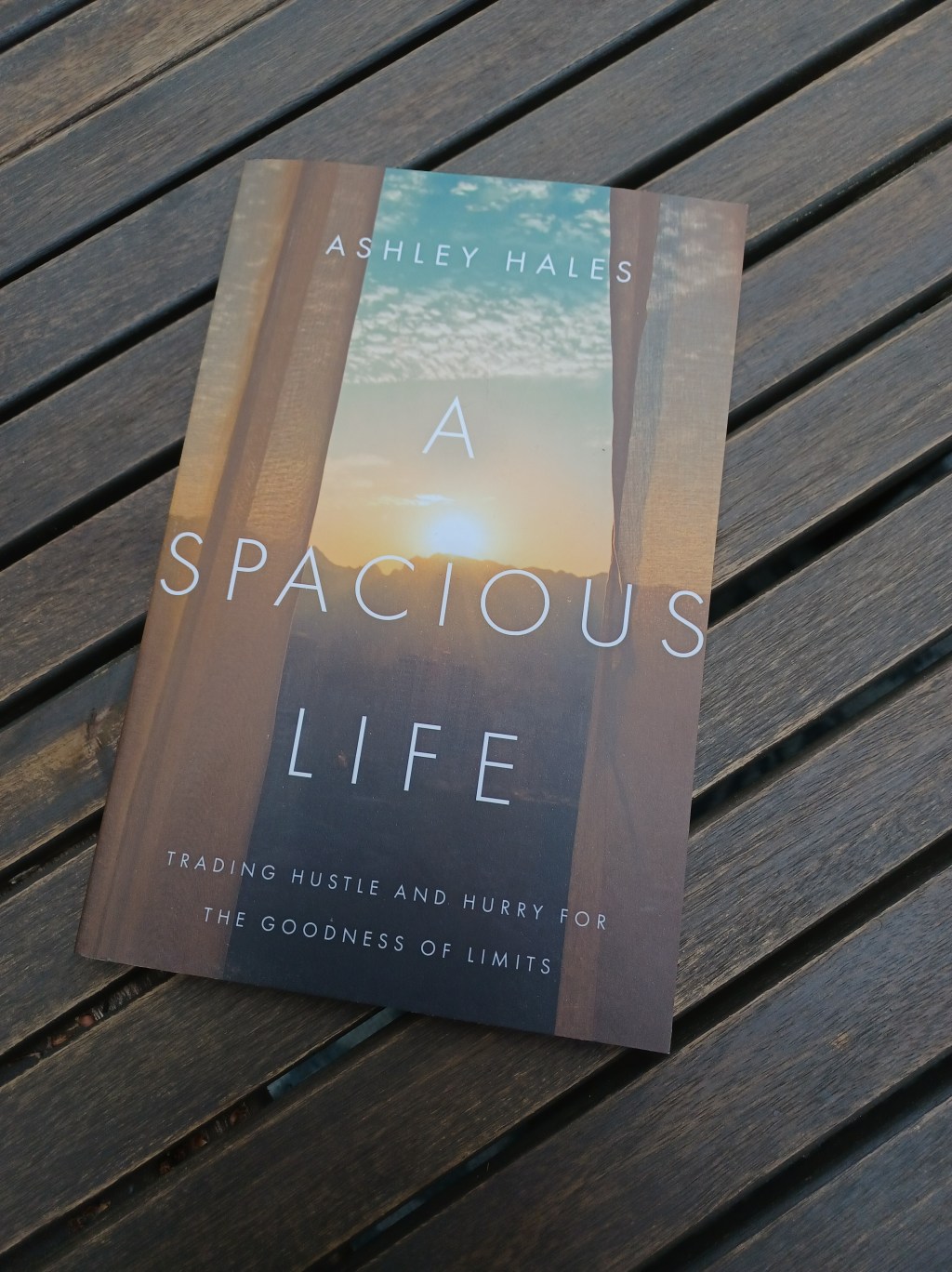
    In her book A Spacious Life: Trading Hustle and Hurry for the Goodness of Limits, Ashley Hales—writer, speaker, and host of the Finding Holy podcast—takes the reader through an exercise of pressing against the various limits of our lives, reminding us that limits exist for our good. These limits can take the form of time restraints, physical limitations, or emotional and spiritual restraints. All can serve, Hales contends, to remind us of our humanness, and God’s limitlessness. 

    When we humans strive to push beyond what we’re capable of, we cease to tell the truth about our role versus God’s role. God is the limitless one, the creator and sustainer. We are created beings, susceptible to weather, traffic, fatigue, sickness, and death. Daily, we Christians get this arrangement backward and become frustrated when we’re not able to escape our limitations. We act surprised when we reach the end of the day and there’s still so much undone. Yet there lies the boundary line. We must rest and go about our work the next day, in a limited, human way, to the glory of God.

    Guardrails

    A helpful metaphor for kind limitations is that of guardrails. We often take these roadside additions for granted, not even seeing them as they form part of the landscape that whizzes by the car window. However, in the event of a treacherous drive, such as an icy trek on unfamiliar roads, those guardrails prove to be a reassuring safeguard. They can save us from plummeting into tragedy. “We think guardrails restrict our freedom,” Hales states. “When freedom is freedom from constraints, we live in a world we control—yet we find ourselves caged by the things we chase. . . . These guardrails don’t take something from us, they actually bestow on us the necessary constraints for flourishing.” (p.112)

    In a series of chapters on such topics as smallness, attention, rest, delight, and community, the author recalls her struggles against her limitations. Of course, I as a fellow mom of many kids related to her everyday struggles against the time and mental energy that make demands on parents. But Hales also draws accurate pictures of the larger human struggle to achieve, hustle, and press outside of our given restraints. She invites the reader to welcome their limitations —a hospitable invitation to a better way.

    Think Local

    The COVID shutdown left us no choice but to focus on our most local life: our homes and the people in and around them. Now that we’re back to a life that looks a bit more normal, the temptation to hurry along is back. We strive through our lives, not noticing what God’s doing. We press forward with our self-made agendas, mowing over our children or our friends in the process. Hales reminds us, “Part of our work as followers of Jesus is resisting the limit to create our own purpose and instead to receive the one God gives us, even if it doesn’t look like what we imagined.” (p.126)

    Each chapter ends with a prayer, thoughtfully composed on the topic covered. In praying about our limits (chap. 2), I’ve pondered her phrase “I speak about hustle with the language of virtue” (p.22) as I see post after post of self-made Instagram entrepreneurs. If you search the hashtag “#hustle,” you’ll see that our culture has made “hustle” into a praiseworthy goal, a performative badge of honor. At its best, “hustle” can serve as shorthand for God-glorifying entrepreneurial drive. But more often than not, I’m concerned that it means “harried effort requiring more than is spiritually, emotionally, or physically healthy.” 

    Six years ago, my husband and I took part in a church planting effort. The team we began with was just 40 people. It’s safe to say I knew everyone on that team fairly well. Now years later, God has granted steady growth to our church, and we have around 300 on a Sunday. I do not know everyone anymore, and I gave up trying to know everyone a long time ago. Occasionally opportunities arise when I’m able to make new relationships, but I’m also learning to love investing deeply where I already am.

    Recall Jesus’ disciples during his earthly ministry: they were constrained to a certain period of time, in a certain geographical location, for the sake of particular relationships. Jesus also interacted with “insignificant” people every day of his earthly life. Some, like Mary, Joseph, Simeon, and Anna, flourished in their limitations. They recognized their own small, yet important, role to play in the story of the coming of Christ. They were grateful to the Father for their position and purpose. Others, like the rich young ruler, allowed limitations to rule their hearts, to their demise. This young man looked to press beyond the limitations of being Christ’s disciple; he wanted to love both his earthly wealth and be justified before God. Mark tells us that “he went away sorrowful, for he had great possessions” (10:22). In the same way, we Christians may either recognize and live peacefully with our limitations, or rage against them.

    Little Space

    A friend recently introduced me to the following hymn, and I thought it was a fitting echo of A Spacious Life. Anna Lætitia Waring, Welsh hymn-writer and poet, penned the following words during her life in the 19th century. In her wisdom, she recognizes the happy limitation of “a little space” meant for glorifying God:

    So I ask Thee for the daily strength,    

      To none that ask denied,

    And a mind to blend with outward life

      While keeping at Thy side;

    Content to fill a little space,

      If Thou be glorified.        

    In a service which Thy will appoints,

      There are no bonds for me,

    For my inmost heart is taught “the truth”     

      That makes Thy children “free”;

    And a life of self-renouncing love

      Is a life of liberty.

    (“Father I know that all my life”)

    I desire more contentment in my “little space” meant to honor God. Ashley Hales has done a service for us in recalling our deep limitations as human beings and reminding us of how they are for our good. Christians ought to find that “there is a spacious life waiting for you inside the narrow gate.” (p.10)  There are many ways in which Christians ought to strive to be like their Father. Being limitless is not one of them.

  • Cosmo Kramer, Nine Months Along

    Cosmo Kramer, Nine Months Along

    (This was originally published ten years ago on my “mommy blog” — remember those? I thought I’d revive it in honor of the child in question’s eighteenth birthday.)

    Today is my third son’s eighth birthday. He would have been an April baby if everything had gone according to plan. But, as these things often do, things went awry.

    Andrew is the only baby whose labor was completely different than the others. With all my other kids, I went into labor a few days early, had steadily increasing contractions — which increased with walking — and less than seven hours later, I was holding a baby in my arms. Jonathan and Maddie came in less than three hours from the time labor began in earnest.

    Andrew, however, was at the mercy of his foolish mother who got excited about a game of Cranium in her enlarged state, and he arrived ten days early.

    We were living in southern California at the time, and the men of the church had gone out of town on a retreat for the weekend. The women who were left home alone decided to get together for a game night. Although my husband had stayed home from the retreat for fear that I would have the baby while he was gone, he told me it would be good for me to get out of the house and have some fun.

    So I went to my friend Amy’s house, where the night began with some karaoke. We had some snacks and moved on to Cranium. If you haven’t played it, Cranium is a combination of drawing, singing, trivia, and charades. Naturally, the charades would fall to the pregnant lady.

    As I remember it, the question was an “all-play,” which means that I was competing at the same time as Amy. We were given the name “Kramer,” as in Cosmo Kramer, as in Jerry Seinfeld’s neighbor.

    Here is the problem. We were in a room full of women who were either too young, too holy, or too busy to have watched Seinfeld. It ended up that Amy and I were the only people who knew who Kramer was. So basically we were given the impossible task of getting people to guess something they would never, ever guess. The closest thing we could hope for was that maybe someone had seen a commercial with him in it. Or lightning would strike and someone would just happen to say the right name. Let’s just say the odds were LONG.

    But Amy and I were good sports and maybe too competitive for our own good, and so as the timer began, we started our Kramer impersonations enthusiastically. Since we were in Amy’s front room, right by the door, I decided to use the door as a tool, because Kramer is known for his entrances:

    This exit/entrance strategy was especially perplexing to a few team members because they thought I was going home.

    Onward we forged, for the full minute allotted, with our poor team members shouting out, “You’re coming home! Hair! Door! Oh, it’s that guy…oh, I don’t know his name..Sorry!”

    As the time ran out, I made one more spectacular attempt, sliding in the door and up against the wall. I continued my Kramer-esque jerky movements along the wall, hoping someone – anyone – would have a moment of inspiration and shout out the right name. However, whereas Michael Richards (the actor who played Kramer) is a lithe, sprightly man with otherworldly physical comedy skills, I was a thirty-five-pounds-overweight, off-balance, pregnant woman who carried WAAAAYYY out in front.

    I slid along the wall and suddenly realized that my weight was causing me to steadily gain momentum. I can see it even now in slow motion…sliding, sliding, jerking, faster…faster…until I was headed in a definite downward direction towards Amy and Uel’s beautiful white ceramic tile floor.

    To the women in the living room, I imagine this looked like I was going along with the imitation until I suddenly dropped out of sight behind the couch. They just thought I was really into it. Kramer is REALLY clumsy sometimes! They all roared with laughter!

    Meanwhile, I was face down on the floor checking to make sure all my teeth were in place. Miraculously, I hadn’t fallen on my belly, but I remember my face hitting pretty hard, and I was laughing at the time, so I quickly slid my tongue over my front teeth to make sure they were all there. Yes, (phew!) yes, they were. The last thing I wanted was a picture from the hospital with my new baby, smiling away looking like a hockey player. Vanity, thy name is Kelly.

    I remember the moment when the girls realized that I hadn’t popped up yet, and they all yelled, “OH! KELLY!” at the same time. They were all sympathy and compassion and I was laughing at myself, feeling humiliated.

    After the games were over, I drove home and started having contractions. They were on and off all night, and then finally stopped. We got up for church as normal, put a chicken in the crockpot for lunch, and headed off for Sunday service. As soon as I sat down in Sunday School at 9 AM, contractions started up again.

    It was a sluggish labor, and contractions never picked up unless I remained absolutely still. Eventually, at six that night, my doctor gave me Pitocin to help things along. It certainly did that. Andrew was born shortly after seven. In the picture from the hospital — which is in storage, or I’d post it — you can see my top lip is slightly swollen. This change is an improvement for me since I normally have almost no upper lip.

    I do have all my teeth in that picture. I haven’t tried impersonating Kramer since.

  • A Word for the Redbuds Among Us

    A Word for the Redbuds Among Us

    (Heads up: this essay contains major spoilers on some super old things and light spoilers on season two of Ted Lasso.)

    Spring has landed in Charlotte. Maybe it hasn’t happened where you are, but here we’ve had blooms for about a month. Camellia blooms kick off the year in January. Then the daffodils make their appearance. And after that come two trees: one I love, and one I hate.

    Because I don’t want to spend much time on it, I will briefly mention that my hated tree is the Bradford Pear. It looks innocent enough: beautiful white blooms perch atop an arched crown of branches. But these trees are too fast-growing to support themselves for long. They split easily in wind and winter weather. Instead of strengthening the forest, they make every tree around them weaker. They also smell like dead fish.

    In the other corner, my beloved tree sits: behold, the graceful Eastern Redbud. These little trees also bloom in March and April, but they are brilliant purple. They nestle in among other trees, content to grow in shady areas when they need to. The Arbor Day Foundation tells us that “George Washington reported in his diary on many occasions about the beauty of the tree and spent many hours in his garden transplanting seedlings obtained from the nearby forest.”

    Maybe you are chuckling at my drastic personification of these trees, making one a virtuous beauty and another a vile-smelling, evil underminer. But they are instructive to me. Let me explain.

    I learn from the redbud tree, as it sits in the shade of the others. It doesn’t clamor for glory — or even much sunlight. It doesn’t shove its way to the top. It adds beauty where it is, being in second place.

    I’ve always been intrigued by the story of Michael Collins. Do you know his name? You probably don’t. But you do know the names Neil Armstrong and Buzz Aldrin. Collins was the man who stayed in the spacecraft while Aldrin and Armstrong were on the surface of the moon.

    Reports at the time depicted Collins as the man who was left behind; he was portrayed as the guy that missed out. What a shame. But Collins never desired such a remembrance. In his memoir Carrying the Fire, Collins wrote “If a count were taken, the score would be three billion plus two over on the other side of the moon, and one plus God only knows what on this side. I like the feeling. Outside my window I can see stars — and that is all.” Later on, he told the New York Times, “I had this beautiful little domain. I was the emperor, the captain of it, and it was quite commodious. I had warm coffee, even.”

    What a brilliant execution of being a person who, to our casual observation, was left out of the most transcendent moment of the 20th century. But Collins had the full picture: he knew he was as integral to the mission as the other two — if he did not fulfill his commitments, the other men would die and it would be a global tragedy. He savored his time alone in the stars, completed his task list, and drank his coffee. Where would the mission have been without him?

    He was a redbud, content to be in the shade.

    I can think of other examples. Where would Karl Malone be without John Stockton? Elton John’s catalog of songs would be short without Bernie Taupin. Harry Potter’s prophecy wouldn’t have been fulfilled without the boy who shared his birthday month, Neville Longbottom. And of course, Frodo wouldn’t have made it up Mount Doom without his devoted Sam Gamgee.

    As the second season of Ted Lasso wound down, we saw a person refuse to stay in the shade. Nate resisted his role as an assistant coach, flatly saying he was tired of giving his boss ideas he’d take credit for. His fellow assistant, Roy, sums it up, “That’s the job, son.”

    Because he was not content to stay in the shade, Nate made everyone around him weaker.

    When I consider proverb after proverb, such as,

    One’s pride will bring him low, but he who is lowly in spirit will obtain honor. (Proverbs 29:23)

    and

    When pride comes, then comes disgrace, but with the humble is wisdom. (Proverbs 11:2)

    I think of the redbud, happy to stay out of the sun and bloom brilliantly anyway. And I think of the redbuds that walk among us: how I overlook them, and how I want to be more like them.

    It is no accident that the words, “God opposes the proud but gives grace to the humble,” comes right after the words, “But he gives more grace.” (James 4:6)

  • The Not-Normal-Yet Winners of 2021

    The Not-Normal-Yet Winners of 2021

    2021: This was the year that some of us learned that a pandemic doesn’t go away just because you pretend it’s over. Huh. Nevertheless, here are some things that made my 2021 better:

    Foodstuffs

    Recipe of the year: Melanie Shankle introduced me to Bon Appetit’s bolognese sauce. The first thing that I love about this recipe is that you mix it up early and let it mellow out for hours on the stove. The second thing that I love about this recipe is that somehow it feeds my entire family of seven adult-sized humans with one pound of ground beef and one box of pasta. I’m not saying that a special blessing of the Holy Spirit is on this recipe, but I just mean it’s a real loaves-and-fishes kind of situation.

    Trader Joe’s Hold the Cone: Peppermint Joe Joe version. These tiny ice cream cones are so delightful, and when combined with our favorite cookie from TJ’s, they are nearly perfect. The only bad thing is that I can’t keep them in the house. As soon as they are here, they are gone.

    Bits of Culture

    Live music. It came back and it was wonderful. We saw The Arcadian Wild, Ellis Paul, Chosen Road, and Andrew Peterson (twice, of course). I think it was at The Arcadian Wild show when I realized we were in this very special moment in time when the artist is perhaps more excited to see the audience than the audience is to see the artist. The first time that artist and audience laid eyes on each other without a computer screen in between was a golden moment. I’m inches away from a soapbox here, but Spotify and music streaming have taken away an entire revenue stream for musicians. If you are able to do so, buy people’s music and go see them in person. Otherwise, they won’t be able to keep making music.

    Seeing movies in the theater. The first one back for me was “In the Heights”; the first one for the whole family was “Black Widow.” If you can do so safely (ie you are vaccinated and abide by the masking rules of your local theater), please go back and support movies on the big screen! No up-to-the-minute living room experience can replicate a communal big screen film experience.

    The Gray Havens Blue Flower album. The Gray Havens have always been inspired by CS Lewis, but here they went all-in on Narnia. Why aren’t more people talking about this one? There’s also a podcast that runs alongside.

    Ted Lasso. My goodness, what a refreshing delight of a television show. For starters, it’s the first time I can remember hearing the words “I forgive you” from one secular TV character to another. Yes, there is a lot of swearing (but our kids watch a fair amount of British TV anyway, and um, the standards are different). Yes, there is an occasional scene that we fast-forward through. But the upsides to this series are so numerous that we’ve joined the numbers of parents who allow our teens to watch it. Here’s a bit that reminded me of so many holidays we’ve spent in Charlotte with displaced out-of-state students and expats around our table (note: the hometowns that Higgins recites here are the actual hometowns of the actors around the table!):

    @sharonsaysso is my Instagram find of the year. This former government teacher lives in Minnesota and patiently teaches her followers about civics, the courts, and constitutional law. Some issues just aren’t partisan — they exist in the laws of our nation. Sharon is going to help you see this. Additionally, she does a huge fundraiser every Christmas where she helps people who are in need of money — they’re about to have their power shut off, or they can’t pay their medical bills, or they can’t buy gifts for the kids. She offers kindness to so many. (Weirdly, this account also exposes me to some of the crazy conspiracy thinking that exists out there, because people ask her questions like “Isn’t President Trump going to be back in office next month?” and I am left thinking, “PEOPLE REALLY THINK THAT?!” But she’s just so gull-durn NICE that people aren’t afraid to ask her these things. I should be more like her.)

    Oddly, my favorite books of the year were the first two I read. Nonfiction’s winner is Alan Jacob’s How to Think. I wish this were required reading for Christians before they are allowed to interact or consume anything on the internet. Fiction’s winner was A Gentleman in Moscow, which reads more like a classic than a modern publication. I will definitely reread both of these books at some point. 

    On a related note, David and I are part of a co-ed book club that has been a consistent joy through the past two years. We’ve patterned ourselves after the “promiscuous reading” suggestions put forth by Karen Swallow Prior in her book On Reading Well, with room for lots of others. Last month’s meeting was a dinner party where we ate gumbo and discussed Flannery O’Connor’s “Parker’s Back” and “Good Country People.” It was the second month we spent on Flannery because we couldn’t leave her alone after month one.

    Other Scraps

    Buying secondhand: Everyone in the house now wears adult-sized clothing, which means the budget for clothes is expanding rapidly. Thank goodness for Poshmark and ThredUp, two online consignment stores that have saved my life this year. ThredUp is where I get most of my clothing now, as well as Maddie’s. Poshmark has everything under the sun; I was even able to get two Premier League jerseys (Christmas presents) for about half the price!

    Kut from the Kloth: I have long heard Sophie Hudson recommend this brand of women’s clothing, especially their jeans. It’s best said with Sophie’s deep Mississippi accent, but these jeans are “cut to fit a grown woman’s behind,” and she’s right. If you don’t like your current jeans and feel like you could do better, look on ThredUp or Poshmark for Kut from the Kloth (because they are pricey new!). You’ll be so happy.

    Ever since I had a spot of skin cancer removed three years ago, I wear Elta Sunscreen daily. It does not feel heavy like sunscreen. It feels like a nice, light lotion. This year I started Maddie on wearing it every day, which I assume means she will never age. At her age, I was right on the cusp of laying out in the sun with baby oil on my legs. Thank you, 1990’s.

    I think that’s it for now! I’d love to hear what your faves are from this year. Sound off in the comments.

  • Efficiency Isn’t Fruitfulness

    Efficiency Isn’t Fruitfulness

    Photo by Debby Hudson on Unsplash

    At this time of year, I see them every time I open a website: ads for planners. Planners with beautiful artwork; planners with gold rings; planners with minimal text; planners that follow the liturgical calendar; planners that have prompts for every thought process you might need to go through over the next day, week, month, or year.

    Don’t get me wrong: I love beautiful paper products, including paper planners. I routinely map out holidays, traditions, goals, and plans on paper. I think better on paper; I think most people do, as it’s an embodied way of going about things that a screen just can’t replace. Plus, who doesn’t love an excellent, well-made pen? Just the right feel, just the right weight, and balance — it’s lovely.

    However.

    At some point in the next month, you might fall into a trap. I know this because I frequently do. The trap is lined in filigreed margins, dotted with bullet points, and sealed with beautiful stickers. The planner industry — and the efficiency experts behind it — are going to remake your life and your identity by their definitions. Those definitions might go something like this:

    • You are a lump of clay waiting to be made.
    • You are a quantifiable entity, able to be captured in numbers and data.
    • You are what you achieve.
    • You are the center of the universe.
    • Your worth is determined in relation to the other people around you. Take your pick where these people may be: your Instagram feed, your office, your playgroup, your neighborhood, your family, or your church. 

    Oh sure, no one is actually going to come out and say these things. But they will use words and phrases like “the best year yet,” or “remake yourself,” or  “achieve your goals,” or “a fresh start,” or “a clean slate.”

    And though at times I use, and even welcome, these ideas, I am here to caution you — and me. 

    The uncomfortable truth is that bad habits from last year followed you into this year, and they might follow you into next year also. Many people I know who would scorn Joel Osteen’s teaching of Your Best Life Now, as it’s a veiled prosperity gospel, still buy into it in some measure. They’re into achieving peak performance right now! Efficiency! Winning the day!

    The thing is, this is not the path to obedience or sanctification that I’ve witnessed at work in the Christian life. Just as the road to hell is marked by a series of little turnings, a gradual descent, the road to sanctification is marked by a series of little uphill battles, a little endurance, and the occasional battle won. It is not the fast-track version of efficiency that the world, as well as many in the church, want to sell you.

    This is true in relationships, as well. Evangelism and discipleship would look very different for the 21st-century church if we made peace with the fact that there are seasons to things, there is gradual progress through time, and we only reap what we sow. Over my lifetime, I’ve seen Christians grow angry over the lack of perceived “progress” in people around them, and they end the relationship. Others are just not bearing fruit as fast as they’d like, so they give up on them. Instead of awareness of slow growth and the patient work of God in themselves, they manifest impatience. They’re done trying; they’re moving on.

    To be truthful, I have also done this at times.

    This is not how God the Father deals with us. Consider Nehemiah 9:17 as just one example of God’s patience with His people:

    They refused to obey and were not mindful of the wonders that you performed among them, but they stiffened their neck and appointed a leader to return to their slavery in Egypt. But you are a God ready to forgive, gracious and merciful, slow to anger and abounding in steadfast love, and did not forsake them.

    As we consider the upcoming year, let us remember that people are not products or measurable goals. Let us be patient, kind, and faithful as our Father in heaven is, to ourselves and to those around us. And may we never confuse efficiency with fruitfulness. The first is what the world lauds; the second is brought forth by the Holy Spirit in God’s economy, at His bidding, in His time.

  • Etsy Roundup

    Etsy Roundup

    Since news sources keep telling us all that the supply chain issues will be an…issue this year, it’s a perfect time to buy from independent artists. Please understand: I have bought one gift so far this year. But maybe this post will inspire me to get going. I hope it does the same for you.

    Here’s a list of some of my recent favorite Etsy shops; some of these merchants I know, some I do not. Most of them have notices in their shop about shipping dates for Christmas. Happy giving!

    Word Art

    One of my favorite new pieces for our home came from LeafBySquiggle: this print of the women in Matthew’s genealogy of Jesus. Having them out at Christmastime is my way of saying, “sorry for all the ways Bible teachers said bonkers things about you all those times.”

    MarcieMason has the CUTEST collection of “You’ve Got Mail” items, which I realize is a very specific set of gifts, but if you’re my friend, we might have this movie in common.

    I recently bought my first Charlotte map from Native Maps, because it was the first one I found that actually had our neighborhood on it. Usually, our neck of the woods is too “fringey” for Charlotte maps. Anyway, they have lots of major cities and look great framed.

    Well-Told has drinkware with maps, quotations, and bookish things. You can even buy a pint glass with the Prohibition bill on it if that’s your thing.

    Literary Gifts

    This category is for those of you who would enjoy giving or receiving a t-shirt that says “unsociable and taciturn.” Come on, that’s funny.

    Ellie Dashwood

    Pixie Hallows

    Lit and Whimsy

    storiarts

    People I know IN REAL LIFE*

    Sierra’s Stitching: Sierra does adorable needlepoint designs.

    Eddy Efaw: Efaw Potter of The Green Ember series, Eddy makes beautiful pottery.

    Growley Leather: Brian and Kelly (and their daughters) do wondrous work with leather. If you’ve seen/smelled my Rabbit Room notebook, you know their work.

    Joe Sutphin: Joe illustrated The Wingfeather Saga. He has some book-related pieces in his shop, as well as other things. This bookmark is a favorite.

    *I have purchased things from all of these humans. 

  • Pandemic Babies Turning One

    Pandemic Babies Turning One

    When the world shut down last year, one population of people saw time keep moving: expectant mothers. Whether she gave birth shortly before the pandemic or anytime during the year, a mom of a 2020 baby had her experience indelibly marked in a way few of us can understand.

    Over the last few months, I’ve gathered thoughts from some of these women about their experiences. A few themes emerged from their experiences: grief over lost moments; unexpected ways in which their community made themselves known and felt; and the joy of a small, quiet, centered life within a tiny circle.

    Aubrey with Tallulah

    When asked what the biggest challenge was with having a new baby in 2020, most moms replied that the isolation was nearly crippling. These women navigated the already emotional time of adjustment with a newborn isolated from regular fellowship with friends and family. Michelle said, “I’d always held expectations for the experience of having my first baby, and hardly any of them were realized. Being alone so much impacted my pregnancy and postpartum experience in ways that I’m still trying to process.” Caroline was robbed of the family experience she had hoped for: “no one but my Mom held [the baby] until he was a month old. It was hard to share the newborn excitement with my sisters and their families when we had a window in between us. It was difficult to give up those precious moments, but at that point, we were trying to make the best decision for our family and the health of our baby.”

    Working from home posed additional challenges for Kristen, who struggled to keep a consistent childcare arrangement for her newborn and toddler. “We hired and lost 3 different in-home nannies during a span of 3 months following my maternity leave and interviewed and offered jobs to several more who ended up not being able to take the position. Some struggled to meet our standards of covid precautions, some had other job opportunities open up, some made choices to move or switch careers because of the pandemic. But all of it meant that instead of being in an office, away from my children during business hours, I was at home, often with them swirling around me. Trying to wear so many hats at once was exhausting and in many ways, even though we’ve had stable childcare for six months now, I still feel like I’m catching up.” Other moms mentioned the consistent anxiety that they or their husbands might contract Covid-19, complicating the pregnancy or endangering the children or grandparents they might encounter.

    Though last year was unprecedented in the challenges it offered, the women also shared some unexpected blessings. Without fail, they replied that the slower pace of the world offered them time as a family. Moms were grateful that their husbands were home to help with the baby. Dads got the opportunity to see developmental milestones that they might have missed had they been working at the office. Families went outside and met their neighbors, as nearly everyone was looking to get out of the house. Aubrey mentioned that she and her husband enjoyed the relative quiet of their time in the hospital: “In other circumstances, we would have had family and friends visiting. But we actually loved that time to recover without visitors—soaking up our new baby, recovering, resting, and preparing to have visitors when we returned home.”

    Shannon and Robert

    Though the isolation was intense, the local church community helped these families in a variety of ways. Every mom mentioned that they had meals dropped off on the doorstep; they still experienced an abundance of gifts and necessary items for the baby. As safety protocols made routine gathering an impossibility, people helped out and gathered in more creative ways. Shannon said, “our church insisted on the importance of staying in contact and even began gathering outdoors at others’ houses and on the lawn in late April / May.” Kristen and Caroline had weekly prayer time over zoom with her community group, all of whom had small children. Aubrey mentioned the help from older couples who reached out to encourage her and her husband.

    Amelia helping mom work from home

    Motherhood in 2020 was strange, whether you had a newborn or older children. The babies of 2020 knew their homes as their entire worlds. “She sat in my office while I worked for the first eight months of her life. Even now as she plays downstairs with the nanny, she’ll see me throughout the day as I go to get lunch or change the laundry. This home and our family are her whole world. That’s already starting to change, but it will forever shape her life that this small place was all that she knew for the first year of her life,” said Kristen. Shannon and her husband enjoyed being home together during the first few months of their first baby’s life: “I recall hours of sitting on the floor of his room, watching him see black and white pictures for the first time, listening to him laugh while we threw the ball for the dog, and documenting his daily smiles to send to family. We were able to do this because there were no other events or plans on our calendar.” Despite “loss and anger and sadness…I’m grateful for the Lord sustaining me and getting me through, even still,” said Michelle.

    Caroline summing up pandemic motherhood nicely, with baby Henry and twins Theodore and Thomas

    Caroline recounted a story of sitting at home one day, exhausted by the daily tasks of keeping up with her two-year-old twins and a newborn. She was worn out and emotionally spent. “I saw a commercial about women who gave birth during the 1918 flu pandemic,” she said. “It ended with the words ‘For all new moms in quarantine, you’re not alone.’ I sat on the couch and wept at the desperately needed words of encouragement. I was part of a larger community that was facing the same unique struggles. I believe that God made humankind to be in community with one another. It’s a gift from our loving Father. With community comes solidarity, and with solidarity comes strength.”

    Michelle and Ariah

    As these babies grow up, I imagine that they will hear comments about their birth year. We always remind our 2001 baby — now twenty years old — that when his grandparents came to visit him the first time, we were able to greet them at the airport gate. Later that year, the world shifted. It has never been the same.

    The world shifted last year in ways we have yet to see unfold. We will likely live with some permanent changes; it remains to be seen what these will be. Amid the loss and grief of the pandemic, I was encouraged that some things kept marching along. They were reminders of God’s goodness to the institutions that withstand sickness and health: friendship. Family. Fellowship. Marriage. Parenthood. In spite of the challenges, weddings kept happening. Babies arrived safely. Though they will remember none of it, the babies of 2020 will serve as a reminder of both intense grief and common grace.