Author: Kelly Keller

  • It’s Time to Pick a Premiere League Club. Here are some thoughts on twelve of them.

    It’s Time to Pick a Premiere League Club. Here are some thoughts on twelve of them.

    It’s almost time for the start of the English Premier League. At this time last year, I was recruited by a friend to help her select a team to cheer for. She is now happily a fan of one of the teams below.

    Now, like that annoying married person who’s had one success fixing up a single friend, I am (wrongly) drunk on success and giddy for more. That means I want to match you to one of the teams below. Kickoff for the next season is Friday, August 11 at 3pm Eastern time, so you’d best get to reading.

    If you have actual in-depth knowledge of the sport, this guide will be of no use to you. But then, if you’re that person, you should have picked a team by now. What are you waiting for?

    This guide is best put to use by people who are trying to be interested — just dipping their toe in the water. It would also be helpful to those who find amusement in funny mascots.

    We love watching EPL partly because it sets a restful tone for the weekend. It’s a nice rhythm to Saturday to brew a hot drink and settle in on the couch in your PJs before the day starts in earnest. However, if you’re a churchgoer, the schedule will be endlessly frustrating to you on Sunday mornings. Proceed with caution!

    Newcastle
    Upside: Newcastle came on strong in the second half of the season last year and finished in fourth. They were the little team that could. They don’t have any superstars to name (though they have many excellent players), but they were hard to beat.
    Downside: Black and white stripes…meh. Their back line (defenders) might be a little weak.
    Notable Players: Kieran Trippier, Miguel Almiron (Paraguay), Callum Wilson (ENG)

    Liverpool
    Liverpool is a powerhouse, both in talent and fan culture. The northwestern city is proudly blue-collar and distinct from the rest of England. The club was founded by people who were priced out of the top tier of football.
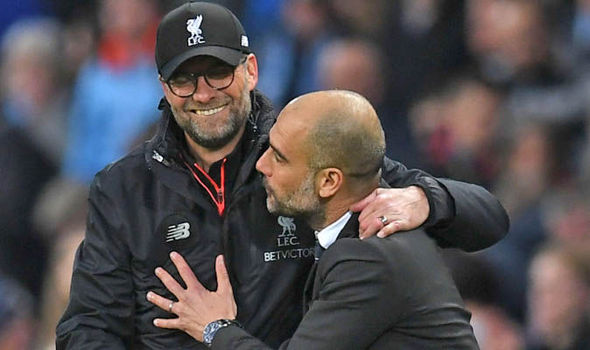
    Upside: Their current manager is a delight: fiery German Jurgen Klopp. Screams when he’s mad at the refs; hugs everyone when it’s over. He’s terribly hard to dislike (I’ve tried).
    Downside: That thing that makes the Boston Red Sox unlikeable? Kind of a little-brother attitude even though they’ve been successful? That’s what Liverpool feels like. Some people would view this as an upside.
    Notable Players: Egyptian Mo Salah, their striker, is amongst the most dangerous scorers in the sport.

    Manchester City
    I root for Man City largely because my first encounter with Premiere League soccer was the Amazon documentary All or Nothing, focusing on the Man City 2017-18 season. Players like Vincent Kompany and Sergio Aguero (both now retired) won my heart.
    Upside: Their manager, Pep Guardiola. He is from Spain, and before he was at City, he coached what many regard to be the best team in history, Barcelona (2008-2012). Pep is slightly crazy in the way that you want your manager or coach to be. Obsessed, intense, passionate — and he’s funny with the press.
    Downside: If you choose Man City as your team, longtime Premiere League fans will roll their eyes at you and accuse you of being an unthinking bandwagon fan. This is because Man City has been fairly dominant lately. But I think this means you just arrived at the right time. Welcome! There is room for you here. Also, there is the unfortunate “oil money” association that comes with being a City fan. You know all the talk of morality and business dealings that has been going on in the PGA this year? The conversation is years-old in the soccer community.
    Notable Players: Everyone. Seriously, this team is deep. Kevin DeBruyne, the Belgian midfielder, merits a mention here, though. The way he passes is a thing of beauty. City just picked up Erling Haaland, who’s brash and young and doesn’t know enough to hedge his bets, so he just keeps scoring goals.

    Manchester United
    United is the New York Yankees of the Premiere League. They dominated the competition in the 90s and 2000s under their legendary manager, Sir Alex Ferguson. Thus, everyone outside the fanbase feels about United the way they do about the Yankees here in America: anyone but them. They are actually owned by the Glazer family, owners of the Tampa Bay Buccaneers. The fanbase largely hates the Glazers and wishes they would sell. If you spot yellow and green fans in the stands during United matches, that’s an indication that they are anti-Glazer fans.
    Upside: An unrivaled legacy of success. A stake in the most hotly-contested Derbys of the year: the Manchester Derby (City vs United, played twice each season, once at each ground). Their new manager is straight as an arrow and doesn’t put up with foolishness (he benched Christiano Ronaldo, one of the best to ever play).
    Downside: Just, blergh. Do you really want to root for the Yankees of English football?
    Notable Players: I love Marcus Rashford and Jadon Sancho, both young English players just coming into their own. Rashford received an OBE for working to keep poor kids fed during the pandemic.

    Brentford
    Brentford was promoted just recently, in 2021. They have done very well in holding their spot in the top tier.
    Upside: Their manager, Thomas Frank, is incredibly likable and enjoys what he does. He’s easy to root for. If mascots are important to you, Brentford is the BEES, which is adorable. They’re fun to watch in that they are on the small side but work really well together.
    Downside: The squad is a bit young and inexperienced. They recently lost their star striker, Ivan Toney, because he was betting on his matches.
    Notable Players: Ben Mee, Bryan Mbeumo, and midfielder Yoane Wissa; Josh Dasilva is another good midfielder.

    Chelsea
    Chelsea is one of the bigger London clubs, with a long history and a loyal fanbase. They were a force in the 2000s and have continued to compete. They recently went through a tough time with their ownership; they were owned by a Russian oligarch, who sold them when the war in Ukraine began. This brought about many financial challenges for the team. Eventually, they were bought by Todd Boehly, who owns the LA Dodgers. He is ridiculously out of place in the stands because he looks like he is from California because he is from California.
    Upside: Their new manager, Mauricio Pochettino. He is fantastic. I hope the ownership is patient enough to let him have an influence.
    Downside: Chelsea seems to be always flirting with dominance but hasn’t zeroed in recently. They go on winning streaks and then go into a tailspin. It has caused much angst for my son, Jonathan, who cheers for them.
    Notable Players: I’m a big fan of Reece James, who plays right back (his sister plays for Chelsea Women). Raheem Sterling seems to finally be hitting his stride with Chelsea (maybe?).

    Tottenham Hotspur (Spurs)
    Spurs is where you will find Harry Kane, captain of the England team, tied for all-time scorer for England. This is one of the most dominant Premier League teams, usually expected to finish top-four or at least top-six. Anything lower than that is viewed as a failure.
    Upside: They have a beautiful new stadium. It’s stunning. If kits (uniforms) are important to you, I think they have some of the best. Plus they win a lot!
    Downside: You’re never really sure they’re going to win.
    Notable Players: Kane, as I mentioned above. In the World Cup, Kane had to take penalty kicks against his teammate, Spurs keeper Hugo Lloris. Also with Tottenham is Son Heung-min, who is a dangerous scorer at times.

    Wolverhampton Wanderers (Wolves)
    Wolves are my husband’s chosen squad, having been influenced by some English friends who hail from the area.
    Upside: They are called the “Wanderers” in tribute to older teams who didn’t have a stadium for a while. They “wandered” to different locations for home matches. In general, Wolves have a “down-on-our-luck” kind of feel. It’s sort of a Chicago Cubs flavor, which, come to think of it, is maybe why my Cubs fan husband felt comfortable here.
    Downside: They flirted with relegation last year. They finished 13th, but it wasn’t comfortable.
    Notable Players: Fabio Silva (Portugal). Also, their attacker Adama Traore is hilariously out of place on the pitch, since he looks more like an American football player. Apparently, he once claimed that he only does “bodyweight exercises.” Look him up and you be the judge.

    Brighton Hove-Albion
    Brighton is a seaside city to the south, and their team is another “no superstars, just a great team” kind of pick. They lost their (great) manager last year after a successful start, but they eventually recovered from a slide and wound up fifth.
    Upside: Fans of sophomoric humor will enjoy the seagull poop arrangement of the stadium (it has since been remedied). More seriously, this is just an eminently likable set of players who work together well, especially in the midfield and backfield.
    Downside: Their lack of a star striker is making scoring difficult, but maybe this will change this season.
    Notable Players: Lewis Dunk, the tall defender, is usually the captain. Brighton just picked up James Milner, who was with Liverpool until now. James Milner has the unique position of being the Premiere League player I think who looks most likely to get into a barfight.

    Arsenal
    Arsenal is an older London team with a young manager and an even younger squad. They dominated for most of last season before injuries took them down. They finished a tight second behind City. I find it easy to root for them when they’re not playing against my team.
    Upside: They have some really fun lingo. They are the “Gunners,” pronounced (and sometimes spelled) “Gooners.” London teams always get lots of attention. Mikel Arteta, the manager, is intense but very funny, like his mentor Pep Guardiola.
    Downside: We’re having trouble coming up with one.
    Notable Players: So many! This team is very deep. You have Eddie Nketiah, Bukayo Saka, Martin Odegaard, and the USA’s own Folarin Balogun.

    Nottingham Forest
    Upside: I mean really. Can you think of a more charming name for a team?! Their mascot is a TREE. A TREE! Plus, Robin Hood and all that jazz! These guys were promoted last year and they ended up doing really well.
    Downside: Their defense is weak.
    Notable Players: Brennan Johnson from Wales; Nigerian Taiwo Awoniyi and New Zealander Chris Wood are both leading scorers.

    Luton Town
    Upside: If you weren’t sold on the tree thing with Forest, this team is called “the Hatters.” THE HATTERS — like, the people who make hats. This team plays in a tiny little stadium in a neighborhood, and they had to do some construction to be able to host matches for the top-tier teams. If you want the underdogs, here they are.
    Downside: Teams that are recently promoted, like this one, are the most likely to get sent back down. It’s just statistics.
    Notable Players: One of their midfielders is named “Marvelous.” Elijah Adebayo is one of their best scorers. I can’t help you with others because they seemingly came out of nowhere.

    Burnley
    Upside: Burnley is returning to the PL after two years out of it. Their manager, Vincent Kompany, used to play for Pep at City. He is a brand-new manager but he seems to have the hang of things already. He’s easy to cheer for.
    Downside: Again, always a danger picking up a newly-promoted team, but maybe you want to roll the dice here since the squad has been there before.
    Notable Players: Wout Weghorst scored the equalizer in that Netherlands World Cup match that went on forever (maybe you were watching?).

    Alright, I can’t say more words here. I am no doubt going to be criticized for misrepresenting or leaving off someone’s favorite, to which I must answer, “What did you expect?! I am not good at this, but I am having fun.”

  • In Which I am Bossy About Mother’s Day

    In Which I am Bossy About Mother’s Day

    (Back by popular demand: here’s what I wrote to my newsletter subscribers in May of 2022.)

    Hi Guys.

    Maybe this email has been politely forwarded to you by your wife or one of her friends. Welcome, I’m glad you’re here. I’ll try not to take up too much of your time.

    I’m going to fully lean into my position as a mid-40s woman to get bossy about some things. You can choose to ignore me as you would a bossy older sister, or you can choose to listen to me and make this year a lovely one for your wife.

    This is it: the very practical stuff that you might need help with. I get that everyone has different plans, different people, different needs, and different budgets.

    This should not be read as condemning what you’ve done thus far for Mother’s Day. You’re doing great. We’re not dwelling on the past. Let’s huddle up, team.

    First off, you need a plan. If you haven’t thought about Mother’s Day yet, today’s the day. Get a plan. Make some decisions. I think guys get tangled up in knots about what to do, feeling like they’re never going to get it right. Repeat after me: something is better than nothing. Decide to decide. Think it over, make a plan, execute the plan. You do this every day in other areas of your life. Apply that same method here. Make some decisions.

    Here are some things you can do TODAY: call the florist and order flowers to be delivered Friday or Saturday of next week (she gets to enjoy them all weekend!). If she’s the breakfast-in-bed type, locate a pancake recipe to shepherd your children through next weekend. Make a grocery list to shop for next weekend, so you have a nice breakfast for her. Buy a few tiny gift cards for the tiny children to put in their cards for Mom (She will be so happy! They will feel so proud!). Cards can be store bought, or if your kids are little, handmade. Go on Groupon and buy a voucher for a housecleaner or a spa day, which mom can arrange at her convenience.

    Do you have tiny children who cling to your wife like their very lives depend on her? I’m willing to bet that she wants some time alone for Mother’s Day. She wants to think a complete thought.

    If you have older children who are capable of pitching in around the house, consider rallying them to do all those household chores that she nags them about every day of her life.

    BUT ALSO: I will tell you a secret. Mom may instead desire time ALONE IN HER HOME. This is so weird, you guys. SHE IS NEVER IN YOUR HOUSE BY HERSELF. I am going on twenty-two years of motherhood and it’s still very rare that this happens for me. It’s so rare, in fact, that my brain melts a little bit when it happens. I’m not sure what to do when I’m home alone. Perhaps she would like the people to GO AWAY FROM HOME FOR A WHILE.

    BE CAREFUL: if it is her usual job to feed people, she would like to not think about feeding people today. If you choose to take the children away from her for a day, DO NOT BRING THOSE CHILDREN HOME HUNGRY. Feed them. Bring them home happy, fed, drunk on Dad Attention. Have. A. Plan. And Chick-fil-a is not open on Sundays, so that’s a bad plan.

    (How are we doing, team? Still here? OK, we’re almost done.)

    Lastly, she wants to know that she’s doing OK. Tell her. She might feel a little guilty that she’d like some time away from the kids. This is ridiculous. Tell her so. Children are wonderful and also exhausting. We all understand this.

    Fist bump, you guys. I’m in your corner. You can do this. Report back here with how it goes.

    Break!

  • Hail, January

    Hail, January

    (Originally published in 2015)


    I love January. I know it’s cold and dark and everyone’s miserable, but I’m not. I like the excuse to stay in, huddle under a blanket, and make soup. This is probably the month when I like homeschooling the most, because while the rest of the world is outside waiting for buses and warming up the car, we’re still inside sipping hot drinks by the space heater.

    Other months are showy, demanding us to celebrate holidays, decorate loudly, and fill our calendars. January is quiet, slowly allowing the light to grow longer and easing the daffodils up from their sleep. January coos to us, “Free up some space now. Slow down a bit. You need to rest.” If we are wise, we oblige.

    January is full of hope. She hands us a clean calendar and encourages us to dream. She reminds us that we are mortal, hemmed in by hours, days, and weeks, and light and dark. Still, she urges us to rise above and make this year something unique and wonderful.

    January is the clearing-out time. Christmas comes with all its joyful trappings and threatens to take over the place; January is our sister in solidarity saying, “here you may come, and no further.”  We overwhelm donation centers with those things we thought we needed until just now.

    January is kind to us in making us reevaluate. The loud voices in our heads tell us to achieve more! Do more! Go further! January quietly suggests that it might be better to do well at those things we’ve already undertaken — for the glory of God and not ourselves, for the benefit of others.

    We’ll be distracted soon enough by other months. Hail, January. I love you. Do your good work while you’re here.

    lamppost
  • Living with Intention: A Meeting with Myself

    Living with Intention: A Meeting with Myself

    (This was originally published in On the Common in December 2021)

    A date that is coming up on my calendar is my yearly “meeting with myself.” I’ve had a few friends ask about this annual ritual, so I thought I would try to recap some of what I do during that day. It has become a precious time for me, one in which I put the old year to bed (as much as I can) and prayerfully set out intentions for the next year (as much as I can).

    Keep in mind that my thoughts, questions, and intentions are very specific to my job over the years: a stay-at-home homeschooling mother of five children. If this is not your job, your day should look different and consider different things.

    Also, please keep in mind that I didn’t do this last year. It was too difficult for me to think ahead and make plans mid-pandemic. Quite frankly, it was too sad. I felt overwhelmed by a lot of things. If this is how you feel this year, maybe a better use of your time would be to schedule a hike for yourself, or a day of shopping, or a movie marathon at home.

    OK, enough with the caveats. Onward.

    An underrated part of this exercise is going to a place you like. You can do this at your house, for example, if you have little children for whom you are responsible. However, if you can arrange to have the children looked after for a few hours, you will find yourself oh-so-much-more refreshed and able to focus. I usually try to have this meeting during the week between Christmas and New Years, which is quite possibly my favorite week of the year. I think we should call it The Week of Appropriately Low Expectations.

    Anyway, find somewhere you like to be alone: a cafe or a park or a library. Order yourself a pot of tea or a full French Press, and dive in.

    Photo by Kelly Sikkema on Unsplash

    Decluttering

    I begin with what Sally Clarkson calls “decluttering your soul” — a careful evaluation of the need for confession, spiritual weakness, or guilt. Just as we spend time clearing out the clutter from our homes around this time, we can spend some time identifying and praying through things that might need to be addressed at years’ end.

    This part of the day might leave me with things I need to talk through: with a counselor, a friend, a mentor, or my husband.

    Goals for Me/Goals for Others

    Then, I move on to working through goals for the year, in different areas: physical, emotional, and spiritual. This portion includes answering questions like:

    • What exercise/health goals do I have for this year? What measurable steps can I take to achieve them?
    • How can I make sure I’m getting enough rest?
    • Are there improvements I can make to any relationships? Family? Friends?
    • What spiritual disciplines do I want to work on this year? How will I go about it? What books do I want to read for spiritual improvement and accountability this year? What Bible verses would be helpful for me to memorize and meditate on in this season of my life?

    Now, real talk for a second — my number one weakness in this exercise is that I want to do ALL THE THINGS! AS SOON AS POSSIBLE! The key to these questions is understanding the season you’re in, being patient with yourself, and setting realistic goals.

    For me, in years past, this has looked like any of the following (not a complete list):

    • One year, I had some lofty running goals. I put my running schedule on my google calendar because when that’s done, I plan better around it and actually do it.
    • I scheduled a one-on-one with each of my kids each month. These dates also needed to go on the calendar.
    • I made a list of the books I’d like to read or revisit that year. I am never at a shortage for things I’d like to read, but I try to be intentional about which ones would serve my season of parenting, my discipling relationships and my current struggles. This is also the moment when I give myself a lecture about reading books I already own instead of buying more (anyone else?).
    • Every year at this time, I concretely plan for what I’m studying in the Bible this year. “Concretely” means I have to decide today — no putting it off, although I reserve my right to change my mind. This step might involve ordering a book or study.

    The next thing I consider is my marriage. This is a section where I might have more questions for David than answers for myself at the moment. We usually have a follow-up meeting in the following week, considering things like expectations, communication, and the like. We also go over the portions below dedicated to the kids and looking ahead at travel for the year.

    Next, I move on to each of the kids. Are there things that are getting overlooked for any of them? Requests they’ve made? Areas of learning where they might be slipping? Adjustments that need to be made? Ways we can pray for them? Being a mom of a lot of kids means that I sometimes think of them as a group instead of individuals. This is a moment to spend on each one alone.

    Time for Fun

    Then I move on to working on goals for fun. We are a family that likes to go places! Here are some of the ideas I’ve come up with in the past for cultivating fun and rhythms of rest and enjoyment in our family:

    • My younger kids used to enjoy teatime once a week. I put it on the calendar. (You should notice by now that my google calendar runs my life!)
    • I tweaked our approach to evening reading time with David so that it was more restful and less squeezed.
    • I put a date on the calendar each month for us to do “city schooling.” The kids loved to do school in other places, and I did too. A change in atmosphere is so refreshing!
    • The biggie: I wrote down all the trips we want to/need to take in the year, when they were scheduled, and any approximate costs we would incur for them. Here’s hoping we’ll be traveling more in 2022.

    When I’ve worked through myself and the family, if I have time left, I spend time on some other things. Since I’m trying to blog more regularly, I might make a list of topics I’ve been mulling over but haven’t gotten to yet.

    All of this sounds dreadfully boring, doesn’t it? But it nails down some structure for human flourishing. It sets goals for soul-feeding. That’s what we want — to catch these days and bend them to our wills. We want to redeem the time and use it well (Eph. 5:16).

    I want to emphasize that your structure will look different from mine. Life stages, employment, ages of children, and priorities dictate how we spend our time and honor the Lord with it. The schedule may fly out the window due to sickness, adding a baby, moving, job changes, etc. But an underlying structure can give a family a rhythm to return to.

    Related resources that might be helpful:

    Don Whitney’s questions for year-end

    Lore Wilbert’s questions for year-end

    Verses to meditate on during this practice:

    James 4:13-15 Come now, you who say, “Today or tomorrow we will go into such and such a town and spend a year there and trade and make a profit”— yet you do not know what tomorrow will bring. What is your life? For you are a mist that appears for a little time and then vanishes. Instead you ought to say, “If the Lord wills, we will live and do this or that.”

    Psalm 90:12: So teach us to number our days that we may get a heart of wisdom.

    Psalm 90

  • So You’ve Been Invited to a World Cup Viewing Party

    So You’ve Been Invited to a World Cup Viewing Party

    Hi Friends!

    Have you recently been invited to a World Cup party and you’re not really into watching soccer? I am here to help you.

    My credentials are as follows: I have only recently gotten (rather deeply) into soccer fandom in the last five years. Before that, I knew nothing, I thought soccer was mind-numbingly boring, and I last played as a three-year-old on a town rec team.

    Quick note: I’m not a purist about calling it soccer or football. The word “soccer” is actually an English word, even though it’s largely an American term now. It was originally used to differentiate soccer from rugby. Fans and players called it “association football,” shortened to “assoc.” So we should not be fussy about this, everyone.

    We’re going to start out slowly with a glossary, and then build to some more advanced items. 

    Pitch – playing field

    Match – game

    Kit – uniform

    Keeper – goalie

    Clean sheet – a shutout; your opponent didn’t score; this achievement belongs to the defensive players and the keeper.

    Post – these are the vertical poles that support the goal

    Crossbar – this is the horizontal bar across the top of the goal

    Set piece – this is a structured play, like a free kick or a corner kick. 

    Cross – a long pass across the front of the goal, for the purpose of setting up a scorer.

    Brace – this is the goal that puts you up two on your opponent. If you’re winning 2-1, the goal that puts you up 3-1 is the brace.

    Nil – zero, nothing. A score of 0-0 is “nil-nil.”

    Assist – the last person who touched the ball before the guy who scored gets credit for an assist.

    Yellow card – this is a warning for rule-breaking, usually a hard collision or the like. If you get two yellows, that’s the same as a red — you have to leave. A yellow just means you’ve been warned.

    Sent off – given a red card.

    Red card – immediate dismissal from the match, and your team cannot replace you — they have to play with one fewer player (“down a man”). If you’re given a red and you didn’t have a prior yellow, it’s called a “straight red.”  This usually only happens when there’s violent conduct or some other grievous offense.

    Technical area – this is the box where the manager stands. The two managers stand on the same side of the pitch, which makes for some funny confrontations sometimes. Nobody actually wants to fight, but they want to look like they do.

    Free kick – this is when the ref sets the ball down and a player kicks it into play. It happens when there’s a foul or rule infraction on the other team.

    Penalty area – (also called “the box.”) This is the large box around the goal.

    Penalty kick – this is a free kick taken from the top of the penalty box, and it’s limited to the player who shoots and the keeper. Everyone else has to stay back. Sometimes matches end in penalty shootouts, where five players from each team get a penalty kick. This is a terrible, heart-wrenching affair. I once sat next to a keeper’s mom while her son went through a penalty shootout on the pitch in front of us. She said “I’m going to throw up” a lot of times.

    Corner kick – when the ball goes out of bounds at the end of the pitch, a corner kick is given. Most of the players line up in front of the goal, hoping to get a header once the ball is in bounds. Usually, the guy in the corner is one of the team’s best passers. Sometimes he gets lucky and curls it right into the goal, which I have just learned is called an “Olimpico.”

    Nutmeg – when a player kicks it through an opponent’s legs, it’s called “nutmegging” him, or for short, “‘megging.”

    Rabona – this is when a player stands on his front leg and kicks the ball from behind with his other leg. I always question my eyesight when I see this happen.

    Alex Oxlade-Chamberlain showing us a rabona. (Wikipedia)

    Simulation – everyone likes to make fun of soccer players for “flopping” — pretending to be injured. It happens a lot. But you can get carded for “simulation,” that is, faking it. I HAVE A LOT TO SAY ABOUT THIS. But I will save it for the in-person conversation at my house someday. (Want to come over?)

    Extra time – soccer keeps the clock running all the time, so if play stops for an injury, a penalty, or a flop, the refs keep track of how much time has gone by and simply add it on at the end of the period (Soccer has two halves). They do not display how much extra time there is until just before it begins. (The fact that the clock keeps running is one reason why the sport has had trouble catching on here in the USA — there’s not enough time for commercials!) 

    A Friendly – this is a match that, essentially, doesn’t count. It’s not part of a tournament.

    Stuff You Should Know

    The Host Team is the First Team Listed, Not the Second Team Listed. 

    In other sports, it’s “Away Team AT Home Team,” ie, “Falcons at Panthers.” But in soccer, it’s “Home Team HOSTS Away Team,” ie, “Charlotte hosts Chelsea,” so Charlotte is the home team. This was perhaps the hardest thing for me to get used to. Dumb, but I just couldn’t get it through my head.

    The Offside Rule

    This is the thing that Americans love to make fun of and pretend not to understand. Guys, it’s just not that difficult. We have one in hockey, and soccer is just a little bit different. Here’s the gist:

    When the ball is moving forward to the goal, the “most forward” offensive player (usually the striker) cannot run past the last defensive player until the ball is kicked forward by his teammate.

    So when the ball is advancing, that line judge on the sidelines is looking at the most-forward offensive player. The official calls offside if that player passes the defenseman on the other team before the ball is kicked forward.

    That’s it. There are some additional little bits that come into play sometimes, but basically, that’s the whole thing. Easy, right? Let’s stop pretending we’re not smart enough to get this.

    Positions and Formation

    Positions in soccer are as follows: forwards (a striker is a forward), midfielders, and defensemen. Plus the keeper. The keeper wears a completely different uniform (kit) than his team, so that can be really unhelpful and confusing. Just try to pay attention in the pregame.

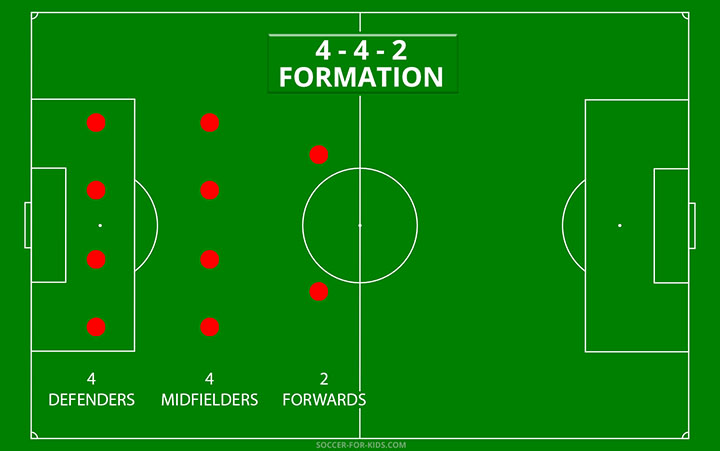
    Also in the pregame, they will probably cover the formation of the teams. Expect to hear a lot of numbers here. The numbers are the amount of people in each position. So if a team is playing a 4-4-2, it looks like this:

    The numbers will always add up to ten because each team starts eleven players counting their keeper.

    Things You Could Say to Make it Seem Like You Know What You’re Talking About

    “Do they usually play in this formation?”

    This will give your friends a chance to talk about other times they’ve seen the team play. They will probably respond with things like, “Well, there was that one match against Germany where they played a 4-2-3-1.” You don’t need to say anything in response. Just nod.

    “He got ball.”

    You can say this when the whistle has blown and there’s a dispute about a foul. Does it look like the player hit the other player with his cleats? If not, you can call it a clean tackle, or say “he got ball.” Someone might yell at you or argue, but that’s ok. That’s what makes this fun.

    “They need to clean up their lines.”

    This refers mostly to the defense, though it could apply to any line of players on the team. If a team is playing good defense, their players are in a line from side to side. They stay relatively even with one another. If they need to “clean up” their lines, it means they are all out of formation.

    “VAR!”

    VAR stands for “video-assisted referee,” and it’s a relatively new addition to world soccer. In the USA, we would call this “instant replay.” There are some refs that sit in a booth and communicate with the officials on the field about penalties and calls. Most fans loathe VAR. If you want to dispute a call or goal on the field, it might be funny to yell “VAR!”

    “They’re parking the bus.”

    If a team scores early, sometimes they stay back by their goal and major on defending. They don’t try to advance and score again. This is referred to as “parking the bus.”

    OK, that’s it for now. If you have any suggestions on how I should endure the match between the USA and England on the day after Thanksgiving, please comment below.

    After the World Cup is over, I’ll be back to try to convince you to watch Premiere League. Cheers!

  • Patience, the Enemy of Pride

    Patience, the Enemy of Pride

    Author’s note: this piece is not about the new movie. I have some thoughts about the movie, but in an effort to draw attention to the greatness of the novel, I’m exploring that here. If you enjoyed the movie, I hope you’ll try the book — but understand that it might be quite different!

    Netflix recently released a new adaptation of Jane Austen’s Persuasion. The novel is not as well known as Pride and Prejudice and Sense and Sensibility, but it remains a quiet favorite of many. The main character, Anne Elliot, is as admirable as characters come in books. She endures the ridiculous, vain members of her family with commendable patience, serving them and carrying on with her duties. She bears great grief over the loss of her mother and the end of a potential love affair seven years past, but she endures with kindness nevertheless.

    The novel’s title is Persuasion because there are so many instances of people being persuaded by others, for better or for worse. Sometimes our advice to others is a help to them; sometimes our advice to others leads to their downfall. Here lies the novel’s first, most obvious lesson: we best be careful before we speak — and before we listen.

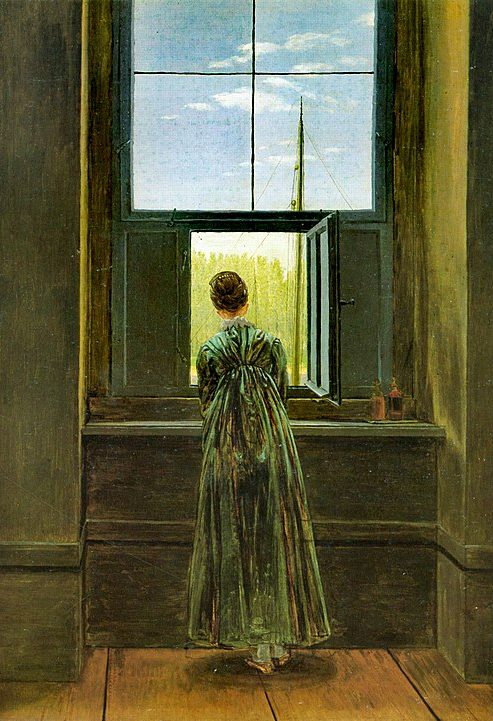
    Woman at a Window, Caspar David Friedrich

    But the question was raised in our most recent book club discussion — would this book have been better-entitled Patience? Karen Swallow Prior based her chapter in On Reading Well on the virtue of patience around the “Longsuffering Anne” of Persuasion. Dr. Prior reminds us that “Because Anne suffers virtuously, she doesn’t let her pain cause her to turn inward upon herself. Rather, her patient bearing of suffering allows her to recognize the suffering of others.”

    Anne endures so much and does so quietly. In contrast, her family members demonstrate foolish pride and vanity. How are pride and patience opposed to one another, and how can we kill foolish pride to awaken patience in our hearts?

    “The Elliot pride” is regarded as the chief vice of the family; Anne’s father Sir Walter Elliot is one of our primary examples. His vanity means that he has an enormous number of mirrors in his room. We first meet Sir Walter as he pores over the book listing the family’s titles and ranking. He insists that there are certain women who ought not visit him in the mornings, as they look terrible in the harsh morning light. When the family is forced to move due to his overspending, he welcomes the chance to make new connections with people of greater social standing.

    Mary, Anne’s younger sister,  is also reported by others to have the Elliot pride. Mary is so self-absorbed that she usually is able to make someone else’s misfortune nothing more than an upsetting turn of events for her. Her child falls and is seriously injured; in response, she is resentful that an important dinner date might be missed. She must be included in everything, and she is convinced that people, including her husband and her sister, think nothing of her.

    Pride, we hear CS Lewis say in his masterpiece Mere Christianity,  is chief among the vices:

    According to Christian teachers, the essential vice, the utmost evil, is Pride.  Unchastity, anger, greed, drunkenness, and all that, are mere fleabites in comparison: it was through Pride that the devil became the devil: Pride leads to every other vice: it is the complete anti-God state of mind.

    Pride gets no pleasure out of having something, only out of having more of it than the next man. We say that people are proud of being rich, or clever, or good-looking, but they are not. They are proud of being richer, or cleverer, or better-looking than others. If someone else became equally rich, or clever, or good-looking there would be nothing to be proud about. It is the comparison that makes you proud: the pleasure of being above the rest. Once the element of competition has gone, pride has gone.  

    What is the “anti-God” part of pride? Pride causes us to make ourselves the center of our own story. Instead of playing a role against a larger plotline of the Lord’s story, we are constantly measuring how it’s going for us, and us alone. We are the main character, the starring role, the essential one. Our position must advance. Said briefly, we put ourselves in God’s place. The goal is our story, not His.

    Here we see Mary’s and Sir Walter’s clamoring for position and rank. How will things turn out for them? — this is their chief concern. The Elliots strove for greater prominence, greater status, and greater attractiveness than everyone around them. They wanted “more of” anything than the next person. Rather than lifting others up, they stepped on others on their way to the top.

    In contrast, Anne abides. She does not strive for position or prominence. Her patience is misunderstood by her family as a lack of interest or ambition; she is “only Anne” to them. They are annoyed by her friendship with an impoverished schoolmate who lives in the wrong part of town. They wonder at her concern for others when she could be advancing in society.

    While the family misunderstands her, she is patient with them. She clothes herself with compassion, kindness, humility, gentleness, and patience. (Col. 3:12) She tends to Mary’s many imaginary maladies; she takes last place in line; she plays piano while others dance. Moreover, she mulls over difficult words when they come her way, ultimately understanding that hard words are sometimes good for our character.

    If you haven’t read the book, my portrait of Anne here is perhaps making you question whether she is even likable. She seems a bit too perfect, perhaps. Indeed, CS Lewis found her to be a character “without fault.” Austen herself confessed in a letter that this heroine was “almost too good” for her. But the inward turmoil of Anne’s past decisions haunts her mind, painting an authentic, tortured portrait of a woman living with the consequences of her actions. 

    It is with this knowledge of past wrongs that Anne is willing to let life and Providence teach her, rather than making herself and her ambitions the center of the story. She sees how she has gone off-track in the past. Rather than forging ahead thoughtlessly, she patiently allows the circumstances to press on her in good and helpful ways, drawing forth virtue from tragedy.

    In the end, because it is a Jane Austen story, Anne triumphs — at the right time, in the proper way. We see in her example that “Pride brings a person low, but the lowly in spirit gain honor.” (Prov. 29:23)

  • The Unlived Life

    The Unlived Life

    “…on days like today, in places like this, in company like this, you get a glimpse of what it all might have been like: the unlived life, and how much happier it might have made me.”

    If you’re not up-to-date on recent English history, it might surprise you to know that the recently-departed Queen, the one who reigned longer than any other monarch in history, was not supposed to be Queen. She was Queen because of the decisions of others. Her uncle, Edward VIII, abdicated the throne after just eleven months. He wanted to marry the American divorcee Wallis Simpson; for so many reasons at the time, as head of the Church of England, he simply could not if he were king. So he stepped aside, the only British sovereign to ever do so.

    In his place came his younger brother, George VI, the one who famously struggled with public speaking. He led the nation through the Second World War, by all accounts doing so quite well. He had two daughters, Elizabeth and Margaret. After sixteen years of his reign, he passed away, leaving his oldest, just twenty-five at the time, as Sovereign.

    Elizabeth was occasionally caught implying that she would have rather been a plain English countrywoman. She was happier in her muck boots in the farmyard than at state dinners with a tiara on her head. I suppose for a short time, as a little girl, she assumed that she would be just that: able to live her life in relative obscurity in the countryside, riding her horse daily and breathing the clean air. It’s understood that she was always happiest in Scotland for this reason. She spent nearly three months every year in the Scottish countryside, perhaps attempting to grasp at that existence that had escaped her.

    Elizabeth II in 1936, the year her uncle abdicated

    There’s an episode of The Crown which attempts to capture this desire of the Queen. Elizabeth is depicted having dinner with a childhood friend, one who has always shared her passion for horsemanship. They are sharing a meal after spending the day in the country, evaluating different horses and riding. She reflects, “Somehow today has managed to be one of the most enjoyable days of my life. And at the same time, one of the most depressing.”

    She goes on, “This is how I’d like to spend all my time…It’s what makes me truly happy. And I actually think it’s what I was born to do…until the other thing came along…that someone else was born to do, that they elected not to do, which meant that first my father, and then I, had to do a job we were never meant to do.”

    Though we can never attempt to relate to Queen Elizabeth’s life — she operated in a realm none of us will ever see — all of us might learn from her assumption of her role, a role she never desired. There come moments when all of us must make peace with closed doors. We must bow the knee to the Lord’s established will.

    These circumstances creep up on all of us. Some are gradual in nature: we make tiny decisions day by day, and suddenly we find ourselves in a different spot than where we thought we would be. Some circumstances come in like a thunderclap: a death. A lost job. A divorce. A rejection.

    Or sometimes, the differences are favorable for the most part, but on hard days, we still wonder what it might have been like somewhere else. And suddenly we are on an island, miles away from where we’d intended to be, grieving what might have been and confused about what happens next.

    Those thoughts come up: what might have been. What might have happened. A different life.

    On our best days, we want to channel Mary’s submission to God in Luke 1: “Behold, I am the servant of the Lord; let it be to me according to your word.”

    But the decisions we make over the course of a lifetime don’t usually have the blazing certainty of an angel visiting us with a word from God. We take steps, we attempt to live faithfully, and eventually, we must make peace with the doors that have been closed to us. We might wonder what might have been, but we must walk forward into what is, trusting that the Lord will meet us there. I am reminded of the passage from Ecclesiastes:

    I have seen the business that God has given to the children of man to be busy with. He has made everything beautiful in its time. Also, he has put eternity into man’s heart, yet so that he cannot find out what God has done from the beginning to the end. I perceived that there is nothing better for them than to be joyful and to do good as long as they live; also that everyone should eat and drink and take pleasure in all his toil—this is God’s gift to man.

    Ecclesiastes 3:10-13

    I am thankful for the Queen’s example in how we might welcome circumstances we would not have picked. The door was closed to her preferred existence when she was just ten years old, by the decisions of her uncle. She took on the role that was thrust upon her when she was just twenty-five. Later she would navigate the rumors and indiscretions of her family; untimely deaths, criminal behavior, and private matters made public. Who knows what tearful hours accompanied her through the “annus horriblus” of 1992.

    By her own statement and others’ reports, she was a woman of deep Christian faith who no doubt leaned on prayer and meditation on God’s faithfulness to see her through. I am chastened to do the same.

    (Plus, it couldn’t hurt to keep riding horses)

    At age 94, during covid lockdown

  • Be a Plodder

    Be a Plodder

    (Republished. Originally shared in January, 2016)

    The other day I was listening to a podcast about home education, a decision in life which requires more than a little long-term perspective. The guest, who had herself raised and educated six children at home, attributed much of her success to being a “plodder.” She said one of her friends called her a plodder after observing how she faithfully, day-in-and-day-out, made her plans and executed them. Her efforts were nothing flashy, but her consistency over the long haul meant that she reaped great fruit after a time.

    I suppose this is nothing more than a retelling of the Tortoise and the Hare, but of course it’s true that “slow and steady wins the race.” All our extravagance and attempts at quick success cannot substitute for consistent effort over the long haul. We cannot make huge strides each day, but we can take one more step, try one more time, get up one more morning and do it again. All of these little efforts add up to more than we could ever achieve in one day of monumental success.

    Plodders are everywhere, but you often don’t see them. They are quietly making progress behind the scenes while the whole world clamors for more attention. They get up early and unlock the church. They put the last few dishes in the dishwasher before bed. They show up on time. They take their vitamins and walk the dog. They make the hard phone call. They practice their instruments every day. They budget. They listen longer and think for a minute, then they get back to work.

    At the top of my plans for school this year I have written in capital letters, “BE A PLODDER.” This sentiment is not to inspire mediocrity in myself or my children, but rather to inspire consistency, or, as the Bible observes it, faithfulness.

    How is God a plodder? Where is He quietly faithful? His excellency is seen in the sun rising each day, the rain falling on the just and the unjust, the turn of seasons, and the steadiness of the tides. This is the quiet, common grace extended to all as a manifestation of His undiminished, extravagant glory.

    But usually, we are all too busy to notice.

  • Imagining for Others: Steinbeck’s East of Eden

    Imagining for Others: Steinbeck’s East of Eden

    I spent most of the last summer with the Trasks and the Hamiltons. East of Eden, John Steinbeck’s masterwork of four-hundred-plus pages had long been on my to-read list, and with the help of my book club, I finally got through it. Steinbeck himself considered it his finest novel; after finishing it, he said “I have put all the things I have wanted to write all my life. This is ‘the book.’” It is not an easy book. It’s quite bleak. The story is Steinbeck’s retelling of the patterns of sin and alienation birthed in the Cain and Abel story in Genesis 4: “And Cain went out from the presence of the Lord and dwelt in the land of Nod on the east of Eden.” (Genesis 4:16)

    Many themes are explored in the book, but what stood out to me as a reader is East of Eden were the instances of people “imagining others” — either for their good or for their ill. Adam Trask, the protagonist in the first half of the book, makes his beloved into a beautiful thing to be attained to, even though she is in fact, as Steinbeck says, “a monster born to human parents.” She is irredeemable in everyone else’s eyes but Adam’s. He is willing to do anything for her, even as she works to destroy him and the life he attempts to build for them.

    A generation later, Adam’s son Aron Trask begins down the same road his father took with a woman: this time with his childhood friend and eventual girlfriend, Abra. Though she is not the force for evil that Cathy was, Abra feels the negative consequences of Aaron’s unsuitable idolatry of her. Aron makes Abra his entire world once he discovers that the adults in his life have all lied to him. From the age of twelve, he is infatuated with Abra; she is the only person in the world to him. By the time he is in college, Steinbeck tells us, Aron has made her “his immaculate dream and, having created her, fell in love with her….The results were love letters that dripped with longing and by their high tone made Abra very uneasy.”

    Later, after circumstances separate the couple, Abra confesses some relief. In a conversation with Lee, a family friend, she says “Lately I never felt good enough. I always wanted to explain to him that I was not good.” “And not that you don’t have to be perfect, you can be good. Is that it?” Lee replies, understanding her. Abra was exhausted by the weight of Aron’s false expectations of her: she knew she could never be the perfect one he perceived her to be. When the pressure was removed, she felt free to be just good.

    On the other hand, Caleb, Aron’s twin, has always been haunted by escaping people’s bad expectations of him. He also has his own bad expectations of himself, understanding himself to be a victim of his inclinations towards evil, inherited from his mother, Cathy. Cal eventually has a moment of clarity when he renounces this idea. Face to face with his mother, he can say “I don’t have to be you… I just know. It just came to me whole. If I’m mean, it’s my own mean.” At last, he knows he is not susceptible, caught up in generational sin, and unable to change things. He is finally able to imagine his way forward.

    I understand that John Steinbeck and I would probably part ways theologically much of the time, but his focus on the imagination in this novel made me, as a Christian, pause. How many of my earthly relationships are affected by this exact phenomenon: I presume someone to be something they are not; or worse, I essentially aid someone in being less than they could be, because I don’t allow for it? Do I hold back encouragement or joyful expectation on someone else’s behalf because I can’t imagine that God would make them, or their circumstances, into something wonderful?

    As Christians, we are all on the path to being made more like Christ. Sanctification is a long road, full of trips and hiccups along the way. What I understand to be sanctification in my own life might look like a stagnant season to you, and vice versa. I wonder how our perceptions of one another — and our tendency to focus on one another rather than run our own race (I Thess 4:11) — might hold back greater encouragement, greater love, and even greater growth.

    We are also prone to be tempted in the other direction Steinbeck explores in the novel: that of idolatry of one another. I often see brothers and sisters set someone on a pedestal: this could be a spouse, a friend, or a spiritual leader of some sort, only to have that person be, in time, unsurprisingly human. The Christian’s hopes are dashed as they see sin and struggle in this person’s life. We will never be truly free to love people in their humanity if we don’t first allow them to be human.

    One instance in Scripture where I speculate that this phenomenon of “imagining for others” plays a part is the story of Barnabas, Paul, and John Mark in Acts 15. When Paul and Barnabas were ready to move on to the next location in their missionary journey, they had a harsh disagreement over John Mark. Was he ready to come along? Paul thought no; Barnabas said yes. They ended up parting ways over the disagreement, and John Mark continued on with Barnabas, while Paul went on alone.

    We cannot conclude from what Scripture offers us, but I wonder about this moment in time with these three men. What role did imagination-for-others play in this situation? Was Paul’s resistance to Mark’s ministry a failure of imagination on his part — one where he simply could not picture Mark being able to handle the demands of the next stage of the early church? Was Barnabas a “son of encouragement” because he was able to see better — imagine better — what the Lord was capable of achieving in and through certain people? 

    Eventually, we come to a happy ending in this story: Paul, at the end of his life, aging in prison, calls for John Mark, as he has become “very useful to me in ministry.” (2 Tim 4:11)

    I find myself chastened to imagine well of others if I am to be a good encourager. It is an act of faith to look at another fallen human being and say, “I can imagine the Lord doing this through you.” It is the heart of encouragement to picture, to imagine, where someone has been and where someone might be headed. It is a bolster to hear from another believer, at least, that now that we don’t have to be perfect, we can be — and we are — good.

  • You Can’t Do Everything: The Goodness of Our Limitations

    You Can’t Do Everything: The Goodness of Our Limitations

    When life shut down in March of 2020, I saw friends adjust in many ways. Families set up rooms for online learning; healthcare workers developed new homecoming routines as they strove to protect their families; birthday parties became drive-by affairs. 

    One friend started sleeping more than he had in decades. This was not the embodiment of some deeper depression or problem, but just that he needed the rest. He would get up, work his corporate America job from home for some hours, eat, and then sleep some more. He slept for hours on the weekends. When he confessed to my husband and me that this was how he was passing the time of intense social distancing, I scolded him in a sisterly manner. “You never stop!” I cried, “do you see how you needed to?” He took the scolding well. He agreed that, since the time he was in graduate school more than two decades earlier, he hadn’t stopped. He is a tireless servant to our church body and a high achiever at work; he hardly ever sets limits on himself. Pandemic restrictions meant that he finally let himself stop, and he benefited from the forced limitations.

    In her book A Spacious Life: Trading Hustle and Hurry for the Goodness of Limits, Ashley Hales—writer, speaker, and host of the Finding Holy podcast—takes the reader through an exercise of pressing against the various limits of our lives, reminding us that limits exist for our good. These limits can take the form of time restraints, physical limitations, or emotional and spiritual restraints. All can serve, Hales contends, to remind us of our humanness, and God’s limitlessness. 

    When we humans strive to push beyond what we’re capable of, we cease to tell the truth about our role versus God’s role. God is the limitless one, the creator and sustainer. We are created beings, susceptible to weather, traffic, fatigue, sickness, and death. Daily, we Christians get this arrangement backward and become frustrated when we’re not able to escape our limitations. We act surprised when we reach the end of the day and there’s still so much undone. Yet there lies the boundary line. We must rest and go about our work the next day, in a limited, human way, to the glory of God.

    Guardrails

    A helpful metaphor for kind limitations is that of guardrails. We often take these roadside additions for granted, not even seeing them as they form part of the landscape that whizzes by the car window. However, in the event of a treacherous drive, such as an icy trek on unfamiliar roads, those guardrails prove to be a reassuring safeguard. They can save us from plummeting into tragedy. “We think guardrails restrict our freedom,” Hales states. “When freedom is freedom from constraints, we live in a world we control—yet we find ourselves caged by the things we chase. . . . These guardrails don’t take something from us, they actually bestow on us the necessary constraints for flourishing.” (p.112)

    In a series of chapters on such topics as smallness, attention, rest, delight, and community, the author recalls her struggles against her limitations. Of course, I as a fellow mom of many kids related to her everyday struggles against the time and mental energy that make demands on parents. But Hales also draws accurate pictures of the larger human struggle to achieve, hustle, and press outside of our given restraints. She invites the reader to welcome their limitations —a hospitable invitation to a better way.

    Think Local

    The COVID shutdown left us no choice but to focus on our most local life: our homes and the people in and around them. Now that we’re back to a life that looks a bit more normal, the temptation to hurry along is back. We strive through our lives, not noticing what God’s doing. We press forward with our self-made agendas, mowing over our children or our friends in the process. Hales reminds us, “Part of our work as followers of Jesus is resisting the limit to create our own purpose and instead to receive the one God gives us, even if it doesn’t look like what we imagined.” (p.126)

    Each chapter ends with a prayer, thoughtfully composed on the topic covered. In praying about our limits (chap. 2), I’ve pondered her phrase “I speak about hustle with the language of virtue” (p.22) as I see post after post of self-made Instagram entrepreneurs. If you search the hashtag “#hustle,” you’ll see that our culture has made “hustle” into a praiseworthy goal, a performative badge of honor. At its best, “hustle” can serve as shorthand for God-glorifying entrepreneurial drive. But more often than not, I’m concerned that it means “harried effort requiring more than is spiritually, emotionally, or physically healthy.” 

    Six years ago, my husband and I took part in a church planting effort. The team we began with was just 40 people. It’s safe to say I knew everyone on that team fairly well. Now years later, God has granted steady growth to our church, and we have around 300 on a Sunday. I do not know everyone anymore, and I gave up trying to know everyone a long time ago. Occasionally opportunities arise when I’m able to make new relationships, but I’m also learning to love investing deeply where I already am.

    Recall Jesus’ disciples during his earthly ministry: they were constrained to a certain period of time, in a certain geographical location, for the sake of particular relationships. Jesus also interacted with “insignificant” people every day of his earthly life. Some, like Mary, Joseph, Simeon, and Anna, flourished in their limitations. They recognized their own small, yet important, role to play in the story of the coming of Christ. They were grateful to the Father for their position and purpose. Others, like the rich young ruler, allowed limitations to rule their hearts, to their demise. This young man looked to press beyond the limitations of being Christ’s disciple; he wanted to love both his earthly wealth and be justified before God. Mark tells us that “he went away sorrowful, for he had great possessions” (10:22). In the same way, we Christians may either recognize and live peacefully with our limitations, or rage against them.

    Little Space

    A friend recently introduced me to the following hymn, and I thought it was a fitting echo of A Spacious Life. Anna Lætitia Waring, Welsh hymn-writer and poet, penned the following words during her life in the 19th century. In her wisdom, she recognizes the happy limitation of “a little space” meant for glorifying God:

    So I ask Thee for the daily strength,    

      To none that ask denied,

    And a mind to blend with outward life

      While keeping at Thy side;

    Content to fill a little space,

      If Thou be glorified.        

    In a service which Thy will appoints,

      There are no bonds for me,

    For my inmost heart is taught “the truth”     

      That makes Thy children “free”;

    And a life of self-renouncing love

      Is a life of liberty.

    (“Father I know that all my life”)

    I desire more contentment in my “little space” meant to honor God. Ashley Hales has done a service for us in recalling our deep limitations as human beings and reminding us of how they are for our good. Christians ought to find that “there is a spacious life waiting for you inside the narrow gate.” (p.10)  There are many ways in which Christians ought to strive to be like their Father. Being limitless is not one of them.