Since news sources keep telling us all that the supply chain issues will be an…issue this year, it’s a perfect time to buy from independent artists. Please understand: I have bought one gift so far this year. But maybe this post will inspire me to get going. I hope it does the same for you.
Here’s a list of some of my recent favorite Etsy shops; some of these merchants I know, some I do not. Most of them have notices in their shop about shipping dates for Christmas. Happy giving!
Word Art
One of my favorite new pieces for our home came from LeafBySquiggle: this print of the women in Matthew’s genealogy of Jesus. Having them out at Christmastime is my way of saying, “sorry for all the ways Bible teachers said bonkers things about you all those times.”
MarcieMason has the CUTEST collection of “You’ve Got Mail” items, which I realize is a very specific set of gifts, but if you’re my friend, we might have this movie in common.
I recently bought my first Charlotte map from Native Maps, because it was the first one I found that actually had our neighborhood on it. Usually, our neck of the woods is too “fringey” for Charlotte maps. Anyway, they have lots of major cities and look great framed.
Well-Told has drinkware with maps, quotations, and bookish things. You can even buy a pint glass with the Prohibition bill on it if that’s your thing.
Literary Gifts
This category is for those of you who would enjoy giving or receiving a t-shirt that says “unsociable and taciturn.” Come on, that’s funny.
Eddy Efaw: Efaw Potter of The Green Ember series, Eddy makes beautiful pottery.
Growley Leather: Brian and Kelly (and their daughters) do wondrous work with leather. If you’ve seen/smelled my Rabbit Room notebook, you know their work.
When the world shut down last year, one population of people saw time keep moving: expectant mothers. Whether she gave birth shortly before the pandemic or anytime during the year, a mom of a 2020 baby had her experience indelibly marked in a way few of us can understand.
Over the last few months, I’ve gathered thoughts from some of these women about their experiences. A few themes emerged from their experiences: grief over lost moments; unexpected ways in which their community made themselves known and felt; and the joy of a small, quiet, centered life within a tiny circle.
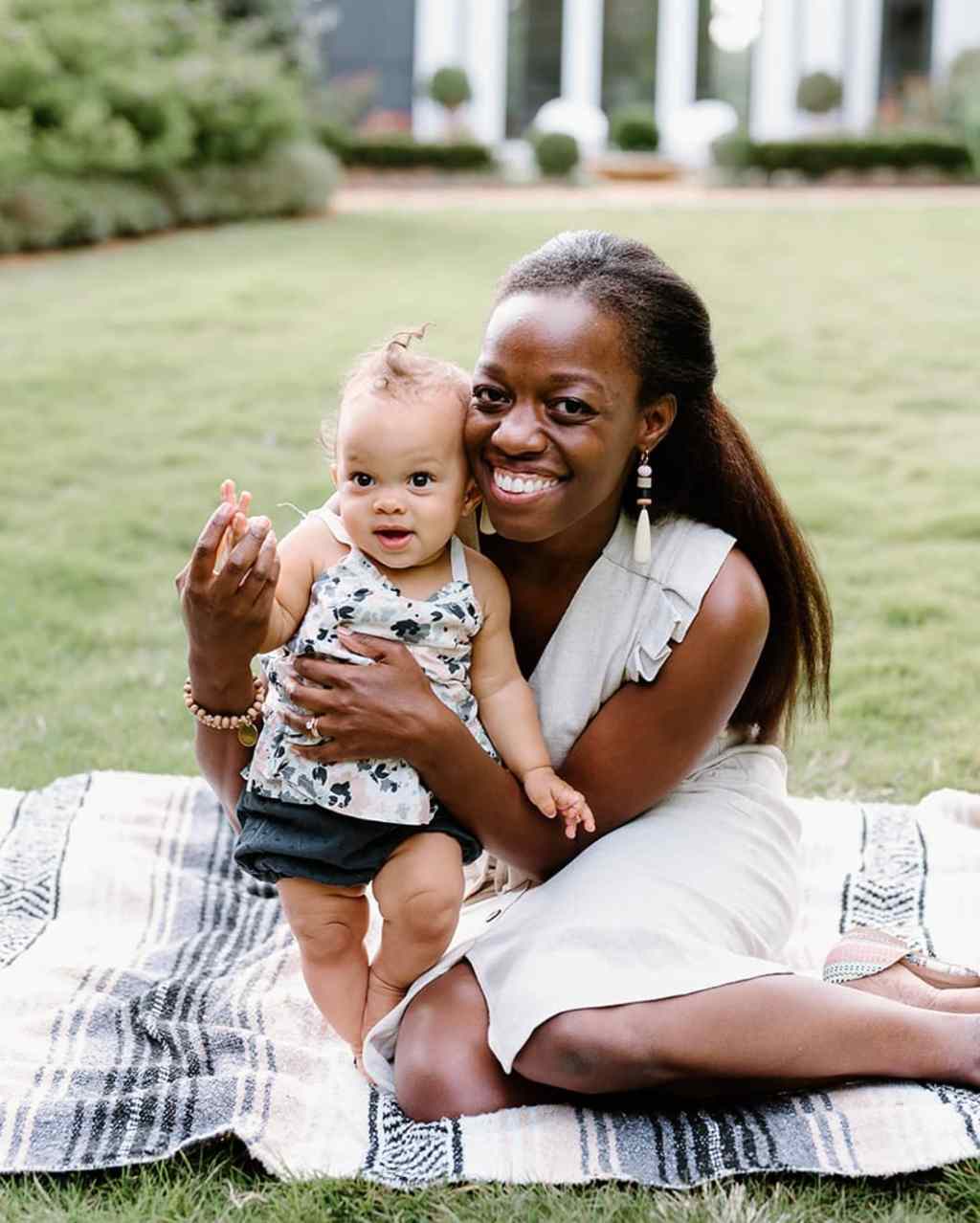
Aubrey with Tallulah
When asked what the biggest challenge was with having a new baby in 2020, most moms replied that the isolation was nearly crippling. These women navigated the already emotional time of adjustment with a newborn isolated from regular fellowship with friends and family. Michelle said, “I’d always held expectations for the experience of having my first baby, and hardly any of them were realized. Being alone so much impacted my pregnancy and postpartum experience in ways that I’m still trying to process.” Caroline was robbed of the family experience she had hoped for: “no one but my Mom held [the baby] until he was a month old. It was hard to share the newborn excitement with my sisters and their families when we had a window in between us. It was difficult to give up those precious moments, but at that point, we were trying to make the best decision for our family and the health of our baby.”
Working from home posed additional challenges for Kristen, who struggled to keep a consistent childcare arrangement for her newborn and toddler. “We hired and lost 3 different in-home nannies during a span of 3 months following my maternity leave and interviewed and offered jobs to several more who ended up not being able to take the position. Some struggled to meet our standards of covid precautions, some had other job opportunities open up, some made choices to move or switch careers because of the pandemic. But all of it meant that instead of being in an office, away from my children during business hours, I was at home, often with them swirling around me. Trying to wear so many hats at once was exhausting and in many ways, even though we’ve had stable childcare for six months now, I still feel like I’m catching up.” Other moms mentioned the consistent anxiety that they or their husbands might contract Covid-19, complicating the pregnancy or endangering the children or grandparents they might encounter.
Though last year was unprecedented in the challenges it offered, the women also shared some unexpected blessings. Without fail, they replied that the slower pace of the world offered them time as a family. Moms were grateful that their husbands were home to help with the baby. Dads got the opportunity to see developmental milestones that they might have missed had they been working at the office. Families went outside and met their neighbors, as nearly everyone was looking to get out of the house. Aubrey mentioned that she and her husband enjoyed the relative quiet of their time in the hospital: “In other circumstances, we would have had family and friends visiting. But we actually loved that time to recover without visitors—soaking up our new baby, recovering, resting, and preparing to have visitors when we returned home.”
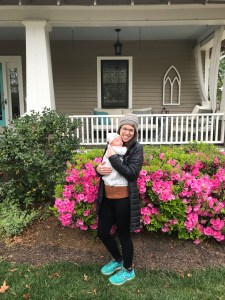
Shannon and Robert
Though the isolation was intense, the local church community helped these families in a variety of ways. Every mom mentioned that they had meals dropped off on the doorstep; they still experienced an abundance of gifts and necessary items for the baby. As safety protocols made routine gathering an impossibility, people helped out and gathered in more creative ways. Shannon said, “our church insisted on the importance of staying in contact and even began gathering outdoors at others’ houses and on the lawn in late April / May.” Kristen and Caroline had weekly prayer time over zoom with her community group, all of whom had small children. Aubrey mentioned the help from older couples who reached out to encourage her and her husband.
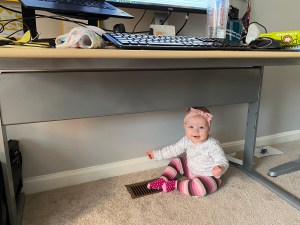
Amelia helping mom work from home
Motherhood in 2020 was strange, whether you had a newborn or older children. The babies of 2020 knew their homes as their entire worlds. “She sat in my office while I worked for the first eight months of her life. Even now as she plays downstairs with the nanny, she’ll see me throughout the day as I go to get lunch or change the laundry. This home and our family are her whole world. That’s already starting to change, but it will forever shape her life that this small place was all that she knew for the first year of her life,” said Kristen. Shannon and her husband enjoyed being home together during the first few months of their first baby’s life: “I recall hours of sitting on the floor of his room, watching him see black and white pictures for the first time, listening to him laugh while we threw the ball for the dog, and documenting his daily smiles to send to family. We were able to do this because there were no other events or plans on our calendar.” Despite “loss and anger and sadness…I’m grateful for the Lord sustaining me and getting me through, even still,” said Michelle.
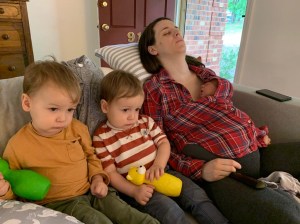
Caroline summing up pandemic motherhood nicely, with baby Henry and twins Theodore and Thomas
Caroline recounted a story of sitting at home one day, exhausted by the daily tasks of keeping up with her two-year-old twins and a newborn. She was worn out and emotionally spent. “I saw a commercial about women who gave birth during the 1918 flu pandemic,” she said. “It ended with the words ‘For all new moms in quarantine, you’re not alone.’ I sat on the couch and wept at the desperately needed words of encouragement. I was part of a larger community that was facing the same unique struggles. I believe that God made humankind to be in community with one another. It’s a gift from our loving Father. With community comes solidarity, and with solidarity comes strength.”
Michelle and Ariah
As these babies grow up, I imagine that they will hear comments about their birth year. We always remind our 2001 baby — now twenty years old — that when his grandparents came to visit him the first time, we were able to greet them at the airport gate. Later that year, the world shifted. It has never been the same.
The world shifted last year in ways we have yet to see unfold. We will likely live with some permanent changes; it remains to be seen what these will be. Amid the loss and grief of the pandemic, I was encouraged that some things kept marching along. They were reminders of God’s goodness to the institutions that withstand sickness and health: friendship. Family. Fellowship. Marriage. Parenthood. In spite of the challenges, weddings kept happening. Babies arrived safely. Though they will remember none of it, the babies of 2020 will serve as a reminder of both intense grief and common grace.
Well. We made it out of 2020. Or at least some of us did. I wish we had more people with us. Here are some things that I recommend based on my last year of life. Some of them might make your life better, depending on who you are.
The Ordinary skincare line: I actually began using this stuff back in 2019, but 2020 gave me more opportunity to try things out and nail down a routine. I usually order from their website, but you can find part of their line at your local Ulta store. I took a bad picture of their store in London last year. Their products are pretty uncomplicated and inexpensive. Here’s what I use:
Rosehip seed oil
Acetic acid
2% Reintoid
Hyaluronic acid
AHA/BHA peeling solution
Glycolic Acid Toner
Mineral sunscreen
I don’t use all of these things every day, but over the course of the week, all of it gets used. One thing I use twice daily that isn’t on this list is TruSkin (vitamin C/hyaluronic acid). I used to use the vitamin C from the Ordinary but I found it too oily. Vitamin C has also helped my kids who struggle with teenage acne (when they remember to use it).
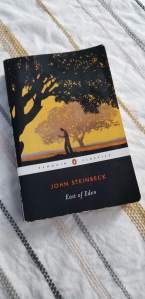
East of Eden: this book has been on my to-read list for years, and I finally jumped in and did it, with the help of my little book club. It is dark, heavy, and glorious. As a writer I could see little episodes where Steinbeck just wanted to include a funny story to lighten things up a bit. It was one of those books that I closed and immediately wanted to begin again. If you read it, tell me.
Nadia Hussain’s noodle jars: when shutdown began in March of 2020, I did a lot of experimenting with food to keep my mind off things. This recipe was a clear winner. It’s a little labor-intensive at first (and the smell of the paste cooking might drive your family or roommate to resent you), but it’s worth it in the end. Basically you make a flavor paste to keep in the fridge. When it’s time to eat, turn on your kettle (or as they say in Australia, “boil the jug”). Put a spoonful of the paste in a small mason jar. Top with uncooked vermicelli (I’ve found that these noodles work the best), frozen or leftover cooked veggies, and meat if you desire (I use canned chicken breast most often). When the water’s boiling, you pour it over the whole mess and let it stand for a little bit. Then you have a hot and happy noodle bowl lunch. You can easily do this at work if you have access to a way to boil water. See all of Nadia’s recipes here. You’ll recognize her if you’re a fan of The Great British Baking Show. She also has a show on Netflix.
New York Times No-Knead Bread: while we’re talking about food, let’s talk about the easiest bread you will ever make. The hardest part of making this bread is remembering to start it the night before you want to eat it. It comes out crusty, a bit sour, and airy every single time I make it. I’ve made it so many times this year that I have the recipe memorized (not that impressive. It has four ingredients.). If you want to take another version for a spin, try this no-knead everything bread from King Arthur Flour. I know you’re all doing Whole30 right now, but in February, try this thing.
Amazing Birdseed: This is such a weird one. About halfway through the year I upgraded the kind of birdseed I buy, and we are the most popular lot in the neighborhood now. It turns out the Audubon society really knows something about birds, go figure. It’s been great to watch the huge variety of birds we play host to. I also bought one of these bird feeders for the dining room (where we do school most days) and it’s downright distracting — in the best way. Here is the bird seed I buy at our local Lowe’s.
So there you have it — skincare, books, food, food, bird food. Seems about right for a year at home. What were your winners for last year?
Hi friends. I don’t know if this will turn into an official series for you, but I wanted to do another round of advice to those of you who might be wandering into homeschooling for the first time. This time, let’s talk about what you should consider with schedules and your school’s calendar.
Check your legal obligations
First, you need to know what your state requires of your school. Here in North Carolina, the law states that we ought to run nine months, on a regular schedule, and attempt to achieve the same educational goals as our district. That means for my school, we generally run from mid-August to the end of May, with breaks sprinkled in all the way.
Since we do not want to wear out ourselves or the children, the wise homeschooling parent schedules regular rests. Rests are not only opportunities to stop doing lessons. They are also chances to change the routine and do something different, whether they “feel” needed or not.
You can read more about what some people call “Sabbath Schooling” right here. This habit follows the general pattern of six weeks on, one week off. The week off provides a chance to catch up on household tasks, schedule appointments, and do fun things. It also provides you, the teacher, with some professional development and teacher workday time. You can take time with what’s working, what’s not, and get to that webinar that’s been on your to-do list. Tweak your schedule, order some different books, or do whatever you need to fix things.
Our other regular rest time comes in the form of weekly scheduling. I tend to load up the middle of the week with assignments more than I do the other days. I want Monday to start gently, not frantically, and Fridays I try to leave very light. In a non-COVID world, we frequently use Fridays as a day to pack up books and do school at a coffee shop, in what we call “city schooling.” If you have little ones, I do not recommend this form of city schooling, but you could easily instruct within a four-day week with all elementary students. Save Fridays (or another day) for park days, field trips, and (safely) meeting up with friends. This is a new reality for everyone. Support and time to breathe is key.
Consider a slow ramp-up
I would advise you not to hit the ground running with all your subjects at once. Remember that first week of traditional school? It’s a great deal of learning new routines, rules, habits, and the like. It’s no different at home. Pick a few things for the first week or two, gradually adding as you go. Use the extra time to familiarize everyone with the general flow of the day, the resources you’re using, and household upkeep. We almost always have some sort of tech failure early in the school year, and I’m grateful when it occurs during a partial week so we have grace to catch up.
Lots of things “count”
Often I wish every homeschool parent had a little time in the public and private school systems. There are many reasons for this, but one is — it would eliminate a lot of conversations about “does this count?” When I taught first grade and fourth grade, my students had assemblies, library trips, concerts, movie afternoons, field days, field trips….and the list goes on indefinitely. If you go to the zoo next week, and your kids don’t even fill out a worksheet or anything, it counts. Do you have a garden outside or would you like to plant one? It counts. We had a couple of family vacations to places like Boston and NYC. Did I count those as school days? You betcha.
It won’t take as long
This can be another panicky place for new homeschoolers. Generally, instructional time simply doesn’t take as long, because your student-to-teacher ratio is so low. With younger students, you might easily finish your day’s tasks by lunch. If this makes you uncomfortable, think about how much of a classroom teacher’s day is made up of crowd control. Some things just take longer because there are more kids to consider. You won’t have this reality in your school.
Of course, there will also be days when four math problems take one hour and you wonder what you’re doing with your life. We all have those. Close the book and try tomorrow.
Everyone wants to quit in November and February
Lastly, there are just months that are hard. If you know that they’re coming, you won’t feel quite so upset by them when they arrive. I will direct you to this kind article that I return to again and again. I have found it to be true that a lot of homeschoolers think they’ve made a huge mistake in the months of November and February. Please press on, and remember that many classroom teachers shake their heads at the end of the day and feel like they’re not getting through sometimes. It’s not you. Teaching is difficult, especially when it is grey outside. Keep going.
I began this year dreading another election year on social media. Last time around, I saw things reach such a pitch and pace that I couldn’t really hear much by the time November arrived. I have a few friends who have good, reasonable conversations on social media, but most of the talk seemed like furious yelling by the end of the election cycle.
This year, I wanted to compose some Commandments of Social Media to help me and perhaps others navigate this year.
But then, 2020 happened. And it has continued to happen. For the last six months. And now it’s half over.
Along the way, I have realized that many of my own struggles on social media translate into real-life contexts as well. I’ve seen myself be paralyzed by fear in these days. I’ve felt my brain go blank with the uncertainty of what to do or how to act. I have lashed out in anger at my family. I have given days over to “doomscrolling.” I have been prayerful on some days and prayerless on others.
As a result, my Social Media Commandments have morphed into some Resolutions for 2020, or perhaps better said, Resolutions for the Remainder of 2020 and the time beyond. Resolutions frequently weigh me down, when I take into account the work of God being slow and steady rather than instantaneous. However, my prayer is that these would be a steady guide to my thoughts when I drop into the spells of fear and confusion. They are intended kindly, to myself and to you. Remember that we have a great high priest who sympathizes with all our weaknesses (Hebrews 4).
Resolved: to treat other human beings as image-bearers of God, regardless of their political affiliation or lack thereof.
Resolved: to acknowledge that I probably don’t have all the information.
Resolved: to remember that I am foremost a citizen of a kingdom and a servant of the King, not one of an earthly country or ruler.
Resolved: to work for the good of my earthly country in the small ways I am able.
Resolved: to represent the statements and actions of others truthfully.
Resolved: to live my life in real time with three-dimensional people, and to speak in contexts that provide community and require accountability.
Resolved: to be quick to listen, slow to speak, and quick to forgive.
Resolved: to act from a place of wisdom, service, and love, rather than one of fear.
Resolved: to remember that it is the Lord Almighty who makes kings, peoples, and nations rise and fall.
Resolved: to believe and think about the good headlines (from verified sources) as much as I do the bad ones .
Resolved: to begin the day meditating on eternal truths given for my good rather than temporal truths given in headlines created to drive web traffic and advertising revenue.
Resolved: to refrain from passing and distributing on social media: gossip, uncharitable speculation, or insult.
Resolved: to implement a “Year of Jubilee” policy. In Old Testament Israel, the Year of Jubilee came once in a generation, and it was when debts were forgiven. Forgotten birthdays? Not answering text messages? No worries. It’s 2020. No one has ever done a pandemic before.
Resolved: to implement a “Year of Jubilee” policy going forward into years when there isn’t a pandemic.
Resolved: to be a humble student of history and science, and therefore acknowledge that I am not one impervious to (a) bad research; (b) viruses and pandemics; (c) the political climate of the day and age; (d) my own biases.
Resolved: to have proper expectations of authority, be it police, presidential, or scientific; to have the same expectations of myself in whatever capacity I bear authority.
Resolved: to make good use of the “mute” or “unfollow” button if it helps me better love people in real life.
Resolved: to press into truth, beauty, goodness — both eternal and temporal, both given for my good.
Resolved: to read more books and fewer tweets, articles, headlines, and polls.
One Friday night in November, a shiny black car with New York plates pulled up in front of the Big House on Dawson Road. Four men got out. They were wearing expensive suits topped by long wool coats, and each sported a fedora. As the cases were pulled out and brought up the narrow cement steps into the house, the guests were welcomed inside by the hostess, Annie Armstrong Dawson. She briskly introduced herself to each of the newcomers. “Hello, come in, there’s coffee on the stove. When you’re settled, come downstairs for some pie.” Annie’s Belfast accent was charming, but the men understood that this invitation was more of an instruction.
Annie was used to having her upstairs rooms full of guests during the weekends of hunting season. Every year the second floor of the Big House was occupied with men from all over the Northeast, come to hunt in the acres of wooded hills that surrounded Deer View Farms. The days took on a familiar rhythm: coffee in the early morning hours, a big hot breakfast after the sun rose, quiet afternoons, and then Jack Daniels, cards and cigarettes in the evenings.
After the evening milking, Annie’s son Sam washed up and made his way up the hill and into the kitchen at the Big House. He wanted to meet the men he would take out hunting that weekend. He knew one of the faces immediately from the morning paper. Even to those who weren’t baseball fans — Sam wasn’t — Babe Ruth was a household name and face. Not wanting to embarrass his guest, Sam made no sign of special recognition. He exchanged names with all of the men, shook hands politely, and told his usual few stories about the successes and failures of hunters on the farm. The men laughed along with him easily. After a few instructions for the early morning meetup, he walked the short distance back to his own small home next door.
That Saturday’s hunting expedition was a successful one for everyone but the Babe. Sam watched him spew his frustration after a few narrow misses. Much like he might have at home plate in the Bronx, Babe ground his teeth and spat. Eventually, the band of hunters headed back to the house for breakfast and a nap. They gathered that evening around the farmhouse table in the kitchen of the Big House, drinking too much and telling raucous stories. Annie tried to stay ahead of them, washing glasses and emptying ashtrays.
When the sun rose after hours of hunting the next morning, the Babe still found himself without a trophy. He walked empty-handed back to the house, squinting into the white sunrise and muttering. Even their host, Sam, had bagged a beautiful buck, though the rack was nothing to speak of — it had a broken brow tine on the right side. Still, it would feed his own small family through much of the winter, and Sam was thankful.
After a few hours, the group of men had packed up their belongings and made their way to the car. Sam emerged from the barn in his coveralls, wiping his hands on a towel. He smiled, shook hands, and invited them to come again. The car was laden down with the deer from the weekend, its shiny paint coated with a layer of dust and hair. They drove off and left the farm quiet again.
On Monday morning, Annie performed her morning duties as usual, tending the farm cats and brewing the coffee for the morning break from chores. She fetched the morning paper from the box at the end of the driveway. Back in the kitchen, she poured herself a cup of coffee from the percolator and settled into her usual spot at the yellow table. She smoothed out the front page of The New York Daily News and saw Babe Ruth’s grinning face looking back at her. Next to the bold text “Babe Bags a Beaut,” Ruth crouched triumphantly next to a buck with a broken brow tine on the right side.
Hi friends! All week long I’ve been joking that I ought to open a Remote Quarantine Consulting Business because I’ve homeschooled for thirteen years. However, since schools are now closing right and left, here is some of my best advice for free. Be kind, be wise and be well in these uncertain days.
Time management: It’s OK to take a day or two to pretend you’re on vacation. Sit around in your pajamas and watch movies, etc. But I would suggest that the majority of your days still have a rhythm to them. Get up and get dressed as you usually would. Set a time for breakfast. We usually do something active between breakfast and the start of school (here it’s chores), so they can burn off a little energy before I’m asking them to sit for a while.
Scholarly pursuits: understand the difference between “school at home” and “homeschool.” The sooner you embrace the fact that your home cannot function as your school does, the less stressed everyone will be. For elementary students, I suggest changing activities every 20-30 minutes during actual lesson time. Set a timer to help with this. Then drop the lesson; go outside, send them to read for a bit, or do a read-aloud. Or the one that we homeschool parents love to Instagram: do a read-aloud on a blanket outside with snacks. What a world.
Eat the frog: You guys know the old adage, right? If you knew you had to eat a frog every day, you’d want to do it as soon as possible to get it over with. If there’s a subject that your kid hates, try to do it earlier in the day before you are both tired.
Lean into delight: light a candle. Turn on some music. Pick a book that everyone loves to read aloud together, even if it’s a re-read (check out the resources at Story Warren). Make lunch interesting or take it outside. Go for a walk. Marathon a movie series that your family loves. What is the culture of your family that you can invest in and preserve during this time? Lean hard into that. I think, since our usual English Premier League matches are postponed, we will be watching some old games just for fun.
Let them be bored: it is not your job to amuse the children every hour of the day. They have minds and creative wills of their own — you know this because you’re the one that hears their stories. Force them to use them. They can do it, I promise. Provide open-ended supplies: legos, dollhouses, art supplies, journals. It might take a few days of complaining to work through this, and you’re going to want to turn on the TV. Resist the urge (more on screens in a minute). It’s good for you all to get away from each other (within your quarantine limits) for a little while. A note to parents who like having things “just so” — creative children are usually messy. Make peace with this. It’s a good time to use your timer, both for the “be bored” time and the cleanup time.
Adult human skills: parents who complain about how your kids still don’t know how to do their own laundry, this is your moment! It’s time for home economics class. If they can reach the bottom of that washer, they can do laundry. Make ‘em. Their future roommate/spouse/child will thank you. You can even pick a project in your home and involve them — my youngest helped me paint her room at age 6. It was not as disastrous as you might imagine. Maybe they want to brainstorm meals with you or learn some cooking skills. Then, when they’re back at school and you’re back at work, you can text them and say, “Hey, can you start dinner?” and something great will happen.
Have a plan for screens (the negative spin): set some ground rules, or those screens will overrun your day and everyone will turn into zombies. Here at our house, the kids must finish school and chores before they’re allowed on screens, with some exceptions to email or voxer friends. Try not to turn on the TV “just to see what’s on.” If you can’t say what you’re going to watch or stream, maybe find something else to do. This is difficult — it’s a battle here in our home every day. I could probably do an entire post on just this topic. But if you’d like to investigate more, we use a combination of physical control (the devices have a spot where they stay), wi-fi control (with Disney circle) and device-based control (with the ScreenTime app). When my kids were smaller, I saved screen time up like gold and used it all up when I was trying to make dinner.
Have a plan for screens (the positive spin): like I said before, we’re going to use screens for good things during this time. A movie marathon. Old sports games (have your kids seen the Miracle on Ice? Mine haven’t). Documentaries. We also use devices for chatting with friends, using Marco Polo and Voxer. We use Hoopla for free through our public library for audiobooks, movies, and comics. Libby and Overdrive might be an option for you, as well.
Give grace: Lastly, this is a scary and uncertain time for everyone. Give yourself grace. Give your kids grace. There’s no model for how this should look. Things will be back to “normal” eventually. Go to bed on time; take a shower; take a walk. Start again tomorrow.
The other night, I was in a gathering of women and the topic of favorite Christmas traditions came up. I wanted to pass on to you what I shared that night: in recent years, my family began a tradition with our favorite stories. We have raised our children with read-alouds, so this was a natural way to pay homage to that family culture — even though with mostly teenagers, we don’t get nearly the amount of read-aloud time that we once had!
In the weeks leading up to Christmas, each member of our family selects a Christmas-themed piece to read aloud. We are each responsible to spend some time with the piece — the reader should be familiar with the selection, enough to do a good reading. If there are voices, we’re encouraged to do voices!
Then, in the most informal way possible, we read our pieces to one another. There is no pre-selected order; we simply find little gaps of time on Christmas Eve and Christmas Day in which to pause and listen to something. We commence with the Christmas account from Luke 2, and then progress to the others.
It sounds ridiculously simple, but it has been so nice to revisit these characters and settings each year. Like I told the ladies the other night, my seventeen-year-old son isn’t necessarily going to reread The Wind in theWillows every year, but he loves going back and watching the mouse choir appear on the doorstep.
Here are the selections we’ve enjoyed as a family — in the comments, please share more ideas!
In no particular order:
The Gift of the Magi by O.Henry (mom or dad fight over who gets to read this one) “And here I have lamely related to you the uneventful chronicle of two foolish children in a flat who most unwisely sacrificed for each other the greatest treasures of their house. …They are the magi.”
John Hendrix’ excellent book Shooting at the Stars. A recounting of the Christmas Eve truce of WWI. Since they were little, our boys have been captured by this true story of men who were shooting at one another one day and playing football together the next.
The arrival of Father Christmas inThe Lion, the Witch, and the Wardrobe. “‘I’ve come at last,’ said he. ‘She has kept me out for a long time, but I have got in at last. Aslan is on the move. The Witch’s magic is weakening.’ And Lucy felt running through her that deep shiver of gladness which you only get if you are being solemn and still.”
In the Dark Streets Shineth by David McCullough. A retelling of Winston Churchill’s visit with FDR for Christmas 1941, just after the bombing of Pearl Harbor. From Churchill: “…these same children shall not be robbed of their inheritance or denied their right to live in a free and decent world.”
The conclusion of The Best Christmas Pageant Everby Barbara Robinson. If you haven’t read this hilarious little book about the Herdman family and how they upset a little town’s Christmas pageant in all the best ways, please put it on your list. “But as far as I’m concerned, Mary is always going to look a lot like Imogene Herdman — sort of nervous and bewildered, but ready to clobber anyone who laid a hand on her baby. And the Wise Men are always going to be Leroy and his brothers, bearing ham.”
Harry opens his gifts/the Hogwarts Christmas feast from Harry Potter and the Sorcerer’s Stone. Who needs any prodding to get back to Hogwarts?! We love going back. “On Christmas Eve, Harry went to bed looking forward to the next day for the food and all the fun, but not expecting any presents at all. When he woke early the next morning, however, the first thing he saw was a small pile of packages at the foot of his bed.”
The visit of the field mouse choir in The Wind in the Willows by Kenneth Grahame. This actually contains one of my favorite passages in the entire book: “He [Mole] did not at all want to abandon the new life, to turn his back on sun and air; the upper world was all too strong, it called to him still, even down there, and he knew he must return. But it was good to think he had this to come back to, this place which was all his own, these things which were so glad to see him again and could always be counted upon for the same simple welcome.”
The opening of Little Women by Louisa May Alcott, in which the sisters rally to have a Merry Christmas in spite of hard times. “’Christmas won’t be Christmas without any presents,’ grumbled Jo, lying on the rug. ‘It’s so dreadful to be poor!’ sighed Meg, looking down at her old dress. ‘I don’t think it’s fair for some girls to have plenty of pretty things, and other girls nothing at all,’ added little Amy, with an injured sniff. ‘We’ve got Father and Mother, and each other,’ said Beth contentedly from her corner.”
Last but not least, the conclusion of A Christmas Carol by Charles Dickens. “‘I don’t know what to do!’ cried Scrooge, laughing and crying in the same breath; and making a perfect Laocoon of himself with his stockings. “‘I am as light as a feather, I am as happy as an angel, I am as merry as a school-boy. I am as giddy as a drunken man. A merry Christmas to every-body! A happy New Year to all the world! Hallo here! Whoop! Hallo!’”
A NOTE: also, this is the time to drag out all the pretty illustrated versions of books you’ve been protecting. Just like the fine china, the pretty books are meant to be enjoyed.
“‘No. You’re forgetting,’ said the Spirit. ‘That was not how you began. Light itself was your first love: you loved paint only as a means of telling about the light.’” – Lewis, The Great Divorce
Hello, dear fellow Hutchmooter.
You are now experiencing reentry. Please keep your arms and legs inside the car at all times, and wait until the car comes to a complete stop. Reentry is not pleasant for anyone. It’s a strange mix of feeling full, of having so much to talk about, to share, to process — and maybe you don’t have anyone to do that with. Maybe you have to hit the ground running with small children the moment you enter the door. Maybe you have an unforgiving boss who doesn’t care about your weekend. And you — you’ve been altered, you’ve been fed. You feel different and you wish you could put it into words.
Maybe this was your first time at Hutchmoot, and you were astonished at the restful space that was given to you. You were unhurried in your heartfelt conversations with people who were once strangers, but now are dear friends. You lingered over your coffee, made with care and love and handed to you with a smile. You’re overwhelmed with the simultaneous joy of a creative space like Hutchmoot, but you’re also exhausted and your brain and spirit feel full to the brim. While you don’t want to leave, you feel that if you had one more session to sit through and think through, you might slump over onto the floor out of sheer overload.
Maybe this was a returning time for you. You knew the faces to expect, the hugs to anticipate, and the jokes to be told. You might have opened up on a new level and shed some tears with kindred spirits. You felt, as you have many years before, that this was a home-going of sorts. Yet every year is different, and there are new things to think about and sort through. Your heart feels uplifted and filled. You lingered in the parking lot and didn’t want to leave yet again.
If I may, I’d like to remind you of one very hard thing: Hutchmoot isn’t a staying place; it’s a sending place.
Wherever in the world you’re returning to, you’re sent there. You’ve been placed there by design. You aren’t there by accident. At least for now, and for most of us, Nashville isn’t where we belong.
You, artist/creative type/appreciator, serve a purpose in the kingdom of God in your actual, local, geographic location. You are a part of the body, unlike any other part of the body where you are. You aren’t meant to be like everybody else.
Part of the glory of Hutchmoot is that you feel like people “get” you. You ask them if they’ve read that book, and they have! And they loved it, too! Remember Lewis’ quote about how friendship is born the moment someone says, “What, you too?! I thought I was the only one!” Hutchmoot is full of those moments, and they are delightful and soul-nourishing.
But back at home, you are a bit more unique. Not everyone thinks the way that you do. This, also, is by design. If everyone thought like I did, the budgets would never be balanced and the times tables would never be learned. But that’s because I serve a different function than someone else who excels at those things.
It’s easy to interact in that “you too” manner at Hutchmoot because some of the work has already been done for us. We know that we make a Narnia reference and almost everyone will perk up. We know that people will want to talk thoughtfully about films and not cast them aside out of hand. There are relatively safe conversational spaces to occupy and know you will be welcomed. But that’s because the Proprietor, the Hutchmaster, and the staff have worked very hard to establish grooves for us to run in. The way has been paved, the example has been set, and the space has been made. At home, this is probably not true.
May I suggest that you do some hard work to find those “you too” moments with the members of your local place?
Not everyone there is easy for you to love. You’re not easy for some of them to love, either. Recall Paul’s teaching to the Corinthian church about the parts of the body. You might be an eye who has nothing in common with an ankle or a hand. Remember, you have the most important thing in common: you have Jesus! The body of which you’re a part is the very thing you have in common.
Because you’re good at imagining, let’s imagine for a moment a group of eyes talking to each other. “What a night I had!” one says. “The Body left the contact lenses in overnight and it was a battle all night long.” The other eyes nod in agreement — they’ve experienced that as well. Another pipes up, “I saw the most beautiful meal the other night, but Stomach was a real downer and said we could only have a few bites.” Someone replies, “yes, my Stomach is that way too. Why don’t they understand what we see? How beautiful it is?”
It might take more effort for an eye to have conversations with stomachs, ankles and hands than with other eyes. But they are still part of the same Body, and they can’t do without each other.
I have long felt, as many of you do, that The Rabbit Room is a unique place worth preserving. It’s different, it’s new to some of us, and it’s a haven. Anytime there is a sniff of controversy, we have the difficult conversation or we just do the hard work of lovingly pressing through and forgiving a difference. There is special care taken to major on the majors and allow kind disagreement on the minors, because we can’t let conflict destroy this special place we’ve got.
But this is what the church ought to be to us, as well. Perhaps familiarity with the institution of the local church, and the way it has become lazily enfolded into cultural Christianity, has made us careless in striving for the preservation of it.
If the past decade in America is any indication, there is a shift happening in American culture. We are, slowly but surely, moving from “a Christian nation” (may I say, we were never this — and that’s another post) to a post-Christian one. Though the changes are uncomfortable, the church is being refined. It’s becoming increasingly uncomfortable for people to hang onto churches for the social capital. This is a good thing.
As this shift continues, the need increases for you, Rabbit. Your local body needs your voice of hope. Your vivid descriptions of Heaven. Your songs in the night. They won’t all understand it at first, and some of them will never “get it” at all — at least, not at the level your idealistic heart wants them to. But for those who do, you may function as a life preserver. Russell Moore has made it a habit of saying that the church is moving from moral majority to prophetic minority. As this happens, the songs and stories will grow all the brighter. The church needs its artists and its poets, striving with their musical hearts towards peace in the church and for the hope of Heaven.
So don’t stay in Nashville, Hutchmooter. Go sing to your people at home. Maybe we’ll see you next year. We’ll hug you when you get here.
In our home this week, there has been much discussion of travel. A good number of my Nashville friends are filling up Oxford at the moment, putting on what I hope is the first of many Hutchmoots in the UK. Their Instagram feeds are lighting up with picnics in Port Meadow, walks in the Cotswolds, and pints at the Bird and Baby.
As David made his tea yesterday morning, he let out a little groan. I asked what was on his mind. He said, “I was just remembering our last day in London. I remember making my tea that morning and thinking about how our trip was over…how there would be no more tea in London for us. If we were to ever go again, there would be another last day, and that makes me sad.”
I laughed aloud, thinking about how he had not only jumped to making another trip, but also to that trip already being over. I would call it glass-half-empty thinking; he would call it realism.
There is definitely something about travel that helps me meditate on Heaven. Back in 2014, David and I made our first trip to England, just the two of us. I spent most of the months leading up to the trip in disbelief that it was actually going to happen. On days that were hard, with the usual demands of parenting and homeschooling and all of the rest of it, I would think about how at a definite, set date in the future, I would be landing on the ground in London. I would take a train to Oxford. I would be there! It seemed too good to be true. I could endure a lot of hard days if I kept the goal in mind.
I picked out things I would wear. I anticipated how I would pack. I made list after list of places I wanted to see, knowing full well that there would, in fact, be a “last day,” and I could never see everything. Why oh why can’t travel time and budgets be limitless?
But in eternity, the time and the budget is limitless. Why do we not live more often with this truth in mind? At some definite, set date in the future, we will be with the Lord. We will have all the time in the world to enjoy, to walk, to grow, to rest. We will walk in the Port Meadows of eternity and not grow tired. There won’t be a sad “last day.” We can put of with a lot in the here and now if we keep that in mind.
I don’t mean to say we should check out for now and be “so Heavenly minded that we’re no earthly good.” What comes our way in the here and now is a way of “packing our bags,” of preparing us for the feast and rest to come. We can welcome it with the knowledge that there is a sure and steady hand guiding it to us and for our good.
Let not your hearts be troubled. Believe in God; believe also in me. In my Father’s house are many rooms. If it were not so, would I have told you that I go to prepare a place for you? And if I go and prepare a place for you, I will come again and will take you to myself, that where I am you may be also. John 14:1-3












 Kelly Keller