Author: Kelly Keller

  • For the Rabbits: Hutchmoot is a Sending Place

    For the Rabbits: Hutchmoot is a Sending Place

    “‘No. You’re forgetting,’ said the Spirit. ‘That was not how you began. Light itself was your first love: you loved paint only as a means of telling about the light.’” – Lewis, The Great Divorce

    Hello, dear fellow Hutchmooter.

    You are now experiencing reentry. Please keep your arms and legs inside the car at all times, and wait until the car comes to a complete stop. Reentry is not pleasant for anyone. It’s a strange mix of feeling full, of having so much to talk about, to share, to process — and maybe you don’t have anyone to do that with. Maybe you have to hit the ground running with small children the moment you enter the door. Maybe you have an unforgiving boss who doesn’t care about your weekend. And you — you’ve been altered, you’ve been fed. You feel different and you wish you could put it into words.

    Maybe this was your first time at Hutchmoot, and you were astonished at the restful space that was given to you. You were unhurried in your heartfelt conversations with people who were once strangers, but now are dear friends. You lingered over your coffee, made with care and love and handed to you with a smile. You’re overwhelmed with the simultaneous joy of a creative space like Hutchmoot, but you’re also exhausted and your brain and spirit feel full to the brim. While you don’t want to leave, you feel that if you had one more session to sit through and think through, you might slump over onto the floor out of sheer overload.

    Maybe this was a returning time for you. You knew the faces to expect, the hugs to anticipate, and the jokes to be told. You might have opened up on a new level and shed some tears with kindred spirits. You felt, as you have many years before, that this was a home-going of sorts. Yet every year is different, and there are new things to think about and sort through. Your heart feels uplifted and filled. You lingered in the parking lot and didn’t want to leave yet again. 

    If I may, I’d like to remind you of one very hard thing: Hutchmoot isn’t a staying place; it’s a sending place. 

    Wherever in the world you’re returning to, you’re sent there. You’ve been placed there by design. You aren’t there by accident. At least for now, and for most of us, Nashville isn’t where we belong.

    You, artist/creative type/appreciator, serve a purpose in the kingdom of God in your actual, local, geographic location. You are a part of the body, unlike any other part of the body where you are. You aren’t meant to be like everybody else.

    Part of the glory of Hutchmoot is that you feel like people “get” you. You ask them if they’ve read that book, and they have! And they loved it, too! Remember Lewis’ quote about how friendship is born the moment someone says, “What, you too?! I thought I was the only one!” Hutchmoot is full of those moments, and they are delightful and soul-nourishing.

    But back at home, you are a bit more unique. Not everyone thinks the way that you do. This, also, is by design. If everyone thought like I did, the budgets would never be balanced and the times tables would never be learned. But that’s because I serve a different function than someone else who excels at those things.

    It’s easy to interact in that “you too” manner at Hutchmoot because some of the work has already been done for us. We know that we make a Narnia reference and almost everyone will perk up. We know that people will want to talk thoughtfully about films and not cast them aside out of hand. There are relatively safe conversational spaces to occupy and know you will be welcomed. But that’s because the Proprietor, the Hutchmaster, and the staff have worked very hard to establish grooves for us to run in. The way has been paved, the example has been set, and the space has been made. At home, this is probably not true. 

    May I suggest that you do some hard work to find those “you too” moments with the members of your local place? 

    Not everyone there is easy for you to love. You’re not easy for some of them to love, either. Recall Paul’s teaching to the Corinthian church about the parts of the body. You might be an eye who has nothing in common with an ankle or a hand. Remember, you have the most important thing in common: you have Jesus! The body of which you’re a part is the very thing you have in common. 

    Because you’re good at imagining, let’s imagine for a moment a group of eyes talking to each other. “What a night I had!” one says. “The Body left the contact lenses in overnight and it was a battle all night long.” The other eyes nod in agreement — they’ve experienced that as well. Another pipes up, “I saw the most beautiful meal the other night, but Stomach was a real downer and said we could only have a few bites.” Someone replies, “yes, my Stomach is that way too. Why don’t they understand what we see? How beautiful it is?”

    It might take more effort for an eye to have conversations with stomachs, ankles and hands than with other eyes. But they are still part of the same Body, and they can’t do without each other.

    I have long felt, as many of you do, that The Rabbit Room is a unique place worth preserving. It’s different, it’s new to some of us, and it’s a haven. Anytime there is a sniff of controversy, we have the difficult conversation or we just do the hard work of lovingly pressing through and forgiving a difference. There is special care taken to major on the majors and allow kind disagreement on the minors, because we can’t let conflict destroy this special place we’ve got.

    But this is what the church ought to be to us, as well. Perhaps familiarity with the institution of the local church, and the way it has become lazily enfolded into cultural Christianity, has made us careless in striving for the preservation of it.

    If the past decade in America is any indication, there is a shift happening in American culture. We are, slowly but surely, moving from “a Christian nation” (may I say, we were never this — and that’s another post) to a post-Christian one. Though the changes are uncomfortable, the church is being refined. It’s becoming increasingly uncomfortable for people to hang onto churches for the social capital. This is a good thing.

    As this shift continues, the need increases for you, Rabbit. Your local body needs your voice of hope. Your vivid descriptions of Heaven. Your songs in the night. They won’t all understand it at first, and some of them will never “get it” at all — at least, not at the level your idealistic heart wants them to. But for those who do, you may function as a life preserver. Russell Moore has made it a habit of saying that the church is moving from moral majority to prophetic minority. As this happens, the songs and stories will grow all the brighter. The church needs its artists and its poets, striving with their musical hearts towards peace in the church and for the hope of Heaven.

    So don’t stay in Nashville, Hutchmooter. Go sing to your people at home. Maybe we’ll see you next year. We’ll hug you when you get here.

  • Packing my Bags

    Packing my Bags

    In our home this week, there has been much discussion of travel. A good number of my Nashville friends are filling up Oxford at the moment, putting on what I hope is the first of many Hutchmoots in the UK. Their Instagram feeds are lighting up with picnics in Port Meadow, walks in the Cotswolds, and pints at the Bird and Baby.

    As David made his tea yesterday morning, he let out a little groan. I asked what was on his mind. He said, “I was just remembering our last day in London. I remember making my tea that morning and thinking about how our trip was over…how there would be no more tea in London for us. If we were to ever go again, there would be another last day, and that makes me sad.”

    I laughed aloud, thinking about how he had not only jumped to making another trip, but also to that trip already being over. I would call it glass-half-empty thinking; he would call it realism.

    There is definitely something about travel that helps me meditate on Heaven. Back in 2014, David and I made our first trip to England, just the two of us. I spent most of the months leading up to the trip in disbelief that it was actually going to happen. On days that were hard, with the usual demands of parenting and homeschooling and all of the rest of it, I would think about how at a definite, set date in the future, I would be landing on the ground in London. I would take a train to Oxford. I would be there! It seemed too good to be true. I could endure a lot of hard days if I kept the goal in mind. 

    I picked out things I would wear. I anticipated how I would pack. I made list after list of places I wanted to see, knowing full well that there would, in fact, be a “last day,” and I could never see everything. Why oh why can’t travel time and budgets be limitless?

    But in eternity, the time and the budget is limitless. Why do we not live more often with this truth in mind? At some definite, set date in the future, we will be with the Lord. We will have all the time in the world to enjoy, to walk, to grow, to rest. We will walk in the Port Meadows of eternity and not grow tired. There won’t be a sad “last day.” We can put of with a lot in the here and now if we keep that in mind.

    I don’t mean to say we should check out for now and be “so Heavenly minded that we’re no earthly good.” What comes our way in the here and now is a way of “packing our bags,” of preparing us for the feast and rest to come. We can welcome it with the knowledge that there is a sure and steady hand guiding it to us and for our good. 

    Let not your hearts be troubled. Believe in God; believe also in me. In my Father’s house are many rooms. If it were not so, would I have told you that I go to prepare a place for you?  And if I go and prepare a place for you, I will come again and will take you to myself, that where I am you may be also.  John 14:1-3

  • A Seat at the Table: A Letter to my Single Friend

    A Seat at the Table: A Letter to my Single Friend

    Dear Friend,

    I see you.

    I see you coming into church on Sunday morning; you wade through the foyer packed with moms, dads, and little children running around. You steel your spine as your weekly battle with discontentment rears its ugly head right there at the threshold of the church. I am glad you came. I want you to hear the old words of the hymns, to sing with your brothers and sisters, and hear the Gospel preached to your soul again. It’s OK if you cry. I cry at church, too. Please don’t sit by yourself. You always have a spot in my pew. Let the sound of the congregation’s singing wash over you and remind you that you have a spot at the best table of all.

    I see you extending yourself in hospitality. You invite people into your life and your home regularly. Even when it’s awkward, even when it is hard, you are outward-facing, humbly promoting love and togetherness. You think creatively about how to pull in the outsider. You do not pursue relationships for the sake of finding a spouse; you pursue people because God pursued you. You set an example for the self-involved ones.

    I see you battling for sexual purity in a complex world that attaches no eternal weight to that struggle. The world wants you to give up, to give in, to seek fulfillment in casual attachments. The media builds up sexual bonds as the end-all, be-all, and then invites you to pursue them as though they are nothing but a casual conversation. I see your tears as you go to bed alone and wrestle with your thoughts.

    I see you taking a risk. Your friends wanted to set you up; you are appreciative of their care in that way, so you went. You spent extra time getting ready, all the while telling yourself that he or she should judge you on your heart, not your appearance. You texted a couple friends to ask them to pray and check in. You navigated the introduction and waded through the awkward small talk. You put yourself out there in the most vulnerable way, emotionally speaking. You thought it went well. Then there’s no follow-up; there’s “I just didn’t see them in that way.” And you have to collect yourself again. You’re perpetually the friend, you’re not spouse material.

    Scripture tells us that being single is a unique blessing, as marriage is a blessing; I am sorry for the ways that we as a culture have misrepresented, or at least underrepresented, that. I am sorry for Pinterest and the wedding industry feeding your discontentment. They’re just out to make money, you know. After people get married, these voices immediately switch to making us feel bad about our house or our children or our clothing choices or our children’s clothing choices….

    I think we have underestimated you. I want you to feel the freedom to pursue creativity in ministry in all the ways that having a family does not allow. Please buy the good knives for your kitchen. Set yourself up with things that help you minister well. Get yourself installed in a place where you feel at home, whether that be a house with roommates or an apartment by yourself. If you are fortunate enough to find yourself in a community where you can minister, don’t miss out. Please show up for it.

    We’re really happy you’re here. We want to see you and know you as Christ sees you and knows you. Unity is different from uniformity. You have something to bring to the table. You aren’t children waiting to grow up and get married; you are a part of our body now, with gifts to use for the glory of God and the betterment of the rest of us. We are better because you’re along with us.

    We love you, and we’re thankful for you.

    Kelly

  • How ‘Hamilton’ Reveals C. S. Lewis’s ‘Inner Ring’

    How ‘Hamilton’ Reveals C. S. Lewis’s ‘Inner Ring’

    Last year, I fell down the rabbit hole of the musical Hamilton. I’ve always been a fan of musicals, and the combination of music, character development, and Revolutionary history was irresistible.

    One of the most memorable characters is Aaron Burr, who achieved fame primarily by fatally shooting Alexander Hamilton in a duel. Burr is the narrator of the musical and a complex character with mixed motivations. On my fourth or fifth time through the soundtrack, I came to a realization: Aaron Burr is grasping for what C. S. Lewis calls “The Inner Ring,” and this striving explains much of his destructive behavior.

    The Inner Ring

    Lewis, in his essay “The Inner Ring,” uses the term to describe that place where many of us long to be. We want to be in the know—one of the essential people. We want to be part of that tight circle that’s most important, wherever it may be: in a family, a circle of friends, at work, or at church. Lewis writes:

    I believe that in all men’s lives at certain periods, and in many men’s lives at all periods between infancy and extreme old age, one of the most dominant elements is the desire to be inside the local Ring and the terror of being left outside.

    This is certainly true of Aaron Burr. Most of his time in the play is spent watching Hamilton and resenting his upward progression. Though Hamilton has no family connections and no natural reason to succeed, he doesn’t shy away from asking for advancement.

    He just continues to climb, and this eventually leads to his position as George Washington’s right-hand man. Burr can’t understand how Hamilton’s lack of discretion leads to non-stop success and a seat at important tables.

    Why is Hamilton always on the inside when Burr is left out in the cold?

    The Room Where It Happens

    Burr longs for “The Inner Ring,” but he calls it “The Room Where It Happens.” In a rowdy, brassy show-stopper, he expresses his desire to be in the room where “decisions are happening over dinner”—in this case between Hamilton, James Madison, and Thomas Jefferson. But as usual, Burr has been excluded. This is the moment when Burr finally says explicitly what he wants: just to be on the inside.

    Lewis describes Burr’s longing:

    Poor man—it is not large, lighted rooms, or champagne, or even scandals about peers and Cabinet Ministers that he wants: it is the sacred little attic or studio, the heads bent together, the fog of tobacco smoke, and the delicious knowledge that we—we four or five all huddled beside this stove—are the people who know.

    But, he goes on, it’s more sinister than that. It’s not just being included that we desire—it’s our delight that others have been excluded:

    Your genuine Inner Ring exists for exclusion. There’d be no fun if there were no outsiders. The invisible line would have no meaning unless most people were on the wrong side of it. Exclusion is no accident; it is the essence.

    In Aaron Burr’s story, this struggle escalates until the end of the show finds him bitterly revisiting his constant exclusion in favor of Hamilton. Denied Hamilton’s endorsement for president, he had lost the election to Thomas Jefferson.

    Burr writes Hamilton: “You’ve kept me from The Room Where it Happens—for the last time.”

    The exchange closes with an agreement to duel: “Weehawken. Dawn. Guns drawn.”

    Emptiness of the Quest


    Poor Burr! If only he could have given up the quest to be on the inside. Lewis assures us of the emptiness of this quest:

    Once the first novelty is worn off, the members of this circle will be no more interesting than your old friends. Why should they be? You were not looking for virtue or kindness or loyalty or humor or learning or wit or any of the things that can really be enjoyed. You merely wanted to be “in.” And that is a pleasure that cannot last. As soon as your new associates have been staled to you by custom, you will be looking for another Ring. The rainbow’s end will still be ahead of you. The old ring will now be only the drab background for your endeavor to enter the new one.

    The desire for the Inner Ring creeps into friendships easily, doesn’t it? We are fearful people, desiring acceptance and love. Social media show us tight circles of friends, inside jokes, and meet-ups we weren’t invited to, all providing fertile soil for jealousy. Instead of looking to the Lord for help with our own duties and challenges, we look around, wondering how our life would be different if we were in that circle . . . with those friends . . . living that life.

    “That life” is a mirage, of course, and if we were to experience it, we would find it just as fraught with trouble as our own. The rainbow’s end will remain out of reach, as Lewis tells us. If he had been invited in to The Room Where It Happens, Burr would still never be satisfied. He would not have found the wholeness he sought. The problem was within himself, just as it is with us. Our hearts deceive us and tell us that other people are to blame. The truth is that our idolatry and wrong desires are the problem.

    True Joy Is Outward


    What is the antidote to this ongoing distress? Turning outward. God creates us for community not to serve ourselves, but to serve one another. “Through love serve one another,” Paul reminds us (Gal. 5:13). Or elsewhere, “In humility count others more significant than yourselves. Let each of you look not only to his own interests, but also to the interests of others” (Phil. 2:3–4). What is a quest for the Inner Ring if not looking to our own interests?

    What is a quest for the Inner Ring if not looking to our own interests?

    As we turn our focus outward, looking to serve and enjoy the Lord and others, we may in time, quite by accident, find the reward of true friendship and fellowship. As Lewis puts it:

    And if in your spare time you consort simply with the people you like, you will again find that you have come unawares to a real inside: that you are indeed snug and safe at the center of something which, seen from without, would look exactly like an Inner Ring. But the difference is that the secrecy is accidental, and its exclusiveness a byproduct, and no one was led thither by the lure of the esoteric: for it is only four or five people who like one another meeting to do things that they like. This is friendship. Aristotle placed it among the virtues. It causes perhaps half of all the happiness in the world, and no Inner Ring can ever have it.

    The joy brought by true fellowship in the Lord can never come from clamorous striving for the Inner Ring. For Aaron Burr and his desire to be in The Room Where It Happens, self is on the throne. And as long as we aspire to the same, we’re not in a place to love, serve, and eventually share true selfless community with others. As Lewis concludes, “The quest of the Inner Ring will break your hearts unless you break it.”

  • Feasting: An Act of War

    Feasting: An Act of War

    Author’s note: I shared these thoughts in part during the closing session of Hutchmoot, which is the weekend conference of the Rabbit Room community. If you don’t know what Hutchmoot is, you can check out the website here. For many of the Story Warren crew, it is a blessed time to be inspired and energized to keep on creating.

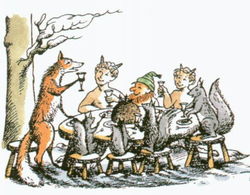
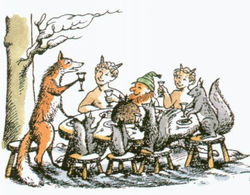
    How Edmund hoped she was going to say something about breakfast! But she had stopped for quite a different reason. A little way off at the foot of a tree sat a merry party, a squirrel and his wife with their children and two satyrs and a dwarf and an old dogfox, all on stools round a table. Edmund couldn’t quite see what they were eating, but it
    smelled lovely and there seemed to be decorations of holly and he wasn’t at all sure that he didn’t see something like a plum pudding.

    At the moment when the sledge stopped, the Fox, who was obviously the oldest person present, had just risen to its feet, holding a glass in its right paw as if it was going to say something. But when the whole party saw the sledge stopping and who was in it, all the gaiety went out of their faces. The father squirrel stopped eating with his fork half-way to his mouth and one of the satyrs stopped with its fork actually in its mouth, and the baby squirrels squeaked with terror.

    “What is the meaning of this?” asked the Witch Queen. Nobody answered.

    “Speak, vermin!” she said again. “Or do you want my dwarf to find you a tongue with his whip? What is the meaning of all this gluttony, this waste, this self indulgence? Where did you get all these things?”

    “Please, your Majesty,” said the Fox, “we were given them. And if I might make so bold as to drink your Majesty’s very good health – ”

    “Who gave them to you?” said the Witch.

    “F-F-F-Father Christmas,” stammered the Fox.

    “What?” roared the Witch, springing from the sledge and taking a few strides nearer to the terrified animals. “He has not been here! He cannot have been here! How dare you – but no. Say you have been lying and you shall even now be forgiven.”

    At that moment one of the young squirrels lost its head completely.

    “He has – he has – he has!” it squeaked, beating its little spoon on the table. Edmund saw the Witch bite her lips so that a drop of blood appeared on her white cheek. Then she raised her wand. “Oh, don’t, don’t, please don’t,” shouted Edmund, but even while he was shouting she had waved her wand and instantly where the merry party had been there were only statues of creatures (one with its stone fork fixed forever half-way to its stone mouth) seated round a stone table on which there were stone plates and a stone plum pudding.

    From the chapter “Aslan is Nearer”
    toast

    I read a quote once about The Lion, the Witch, and the Wardrobe where the author stated that some feasts in Narnia are seen as “acts of war.” Eating and drinking are not normally viewed as a combative act, so the thought piqued my curiosity.

    The animals’ Christmas feast (above) is an act of war to the White Witch because it tells the truth about her authority. The witch views it as an act of treason; she is threatened by the celebration. The thaw is underway, Father Christmas is in the wood, and the witch’s reign is drawing to a close.

    The animals’ feast bellows out hope, joy, and the truth that Aslan is on the move. Who knew that some plum pudding and holly could be so offensive?

    Lewis writes in Mere Christianity, “Enemy-occupied territory–that is what this world is. Christianity is the story of how the rightful king has landed, you might say landed in disguise, and is calling us to take part in a great campaign of sabotage.”

    No doubt you have been at a feast that was an act of war. Perhaps you didn’t realize it at the time, but you have. Anytime you sit at a table with those who share your conviction that Jesus is returning, you declare war on the lies of this world — this mixed-up, passing-away, broken world. You reinstate the truth of creation, joy, and all things made new.

    On the road west to Nashville this past Thursday, my husband and I sat in silence and listened to all of Andrew Peterson’s new album The Burning Edge of Dawn. There is a point on the record where the gloom grows heavy and thick, and the rain keeps falling. The darkness is palpable.

    At times the world and its dark press in upon us relentlessly. We are tempted to give up hope and light and all that we hold dear. The forces of sadness and guilt heap condemnation and defeat upon us.

    Then like a guttural cry from somewhere unknown, the next song rings out:

    Set your face against the night

    and raise your broken voice

    Rejoice

    This line of the song, taken from Philippians, landed on my ear as a war cry. What a strange thing for Paul to do in a dank prison, chained to a guard and waiting for deliverance or death.

    What a strange thing for us to do week in and week out — on birthdays, on holidays, at homecomings, weddings, or church potlucks — as evil targets Christians by name in our world every week, nearly every hour.

    Yet onward we go — together at feasts and communion tables, feasting and making a war cry.

    We rejoice because we are advancing under the leadership of the One True King, who sets the world free from bondage to the enemy forces by His great campaign of sabotage. We raise our broken voices and repel the dark. We join with brothers and defy death in an act of community. We feast on fine food and wine. We conquer armies with a marching band…or a paintbrush…or a pencil…or a guitar.

    I love the passage in the Old Testament where God overturns Israel’s enemies with trumpets and light:

    So Gideon and the hundred men who were with him came to the outskirts of the camp at the beginning of the middle watch, when they had just set the watch. And they blew the trumpets and smashed the jars that were in their hands. Then the three companies blew the trumpets and broke the jars. They held in their left hands the torches, and in their right hands the trumpets to blow. And they cried out, “A sword for the Lord and for Gideon!” Every man stood in his place around the camp, and all the army ran. They cried out and fled.

    -Judges 7:19-22

    At my house on Resurrection Sunday, we raise our glasses and say, “let us eat, drink, and be merry, for yesterday we were dead.”

    Battle stations, everyone — to the feast! Raise a glass in warfare.